
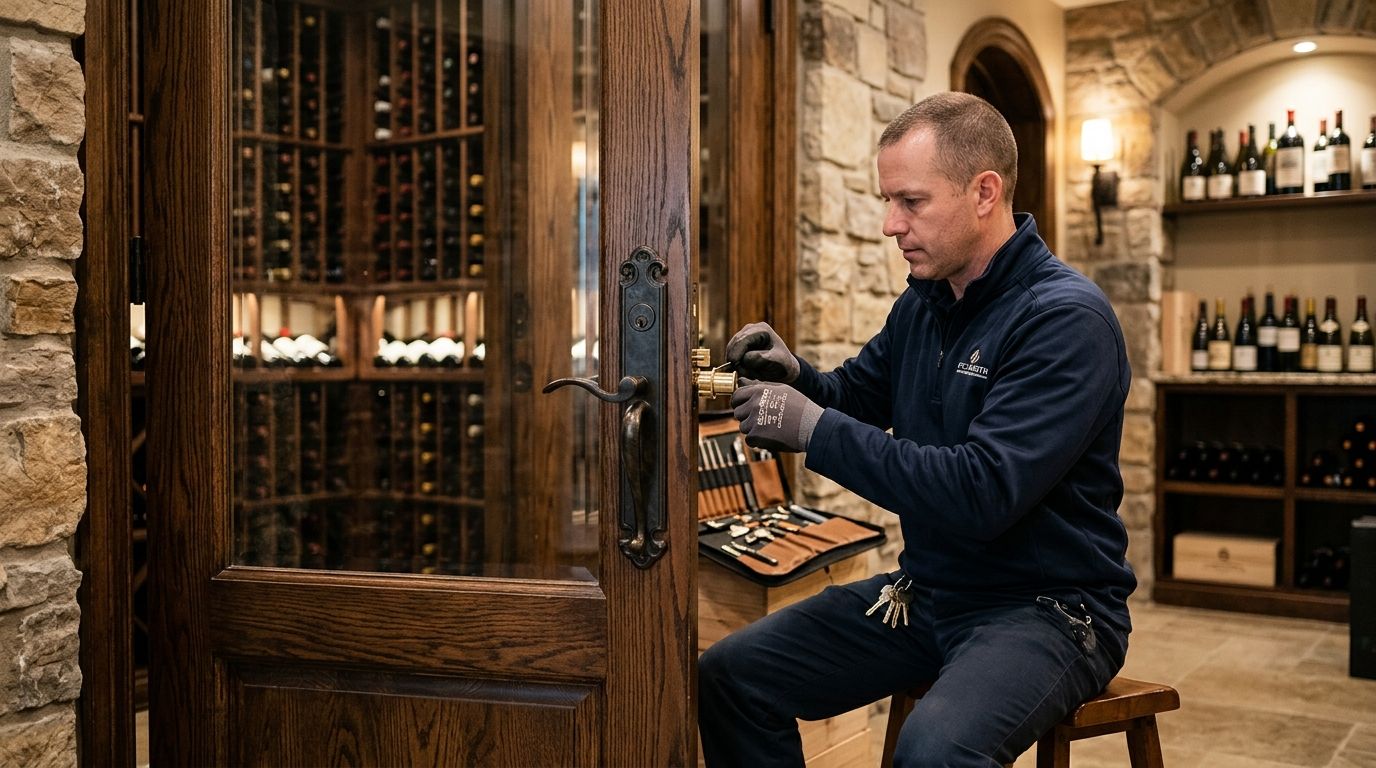
A wine cellar or a specialty storage room in a Massachusetts home holds inventory that's easy to price and hard to replace -- a few hundred bottles, a gun safe closet, a climate-controlled humidor -- and the lock on that door usually gets less attention than the racking inside it. Locksmith for home wine cellars work means fitting hardware rated to survive constant humidity while keeping the room under one accountable key, without fighting the climate control that keeps the collection stable.
- Standard keyed deadbolts corrode fast in cellars run at 50-70% relative humidity -- swap for a corrosion-resistant or electronic model in 2026.
- A locksmith for home wine cellars should key the cellar into the same system as a gun room or home office, not leave three separate keys floating around.
- Apex Lock N Key recommends an ANSI Grade 1 or 2 deadbolt for any room holding insured inventory over builder-grade Grade 3 hardware.
- Electronic deadbolts solve the shared-access problem for families and cleaning staff but need a battery check built into your cellar maintenance routine.
Why this matters for wine cellar and specialty storage owners
Most wine cellars in Middlesex County run in the 50-70% relative humidity range and hold steady around 55°F, which is exactly the environment that corrodes cheap internal lock components over a few seasons. Builders typically install whatever keyed knob or entry-level deadbolt shipped with the door package, because the room's climate system was the budget line item, not the hardware.
That gap matters more once a collection has real value or an insurance rider attached. Homeowners' policies that cover a wine collection, a firearms safe, or a cigar inventory often specify a minimum lock grade, and a builder-grade knob lock rarely meets it. A licensed locksmith for home wine cellars looks at the door, the frame, and the humidity load together instead of just swapping a cylinder.
Assess what's actually protecting the room
Before buying hardware, walk the door the way a locksmith would.
- Check whether the current lock is a keyed entry knob (low security) or a deadbolt (better, if it's rated Grade 1 or 2).
- Look at the strike plate screws -- short screws into the jamb only, not the framing, is the most common weak point.
- Test the door itself for gaps around a French or glass-panel door, common on cellar entries.
- Note any visible corrosion or stiffness in the existing mechanism, a sign humidity has already gotten to it.
- Confirm who currently holds a key -- contractor, cleaning service, family members -- and whether that list is still accurate.
Choose hardware built for humidity, not just style
Cellar doors get chosen for looks first: reclaimed wood, iron strap hinges, glass panels. The lock needs to survive the environment behind that look.
- Pick stainless or solid-brass internals over standard zinc-alloy components, which pit and seize faster in damp air.
- Confirm the deadbolt is rated ANSI Grade 1 or 2 if the room holds insured inventory; Grade 3 is builder-grade and not rated for security-sensitive spaces.
- Match the finish to the room's humidity exposure -- some coatings hold up better against constant moisture than others.
- Avoid electronic components with exposed circuit boards in rooms that run near 70% humidity unless the unit is explicitly moisture-rated.
- Ask about anti-pick and anti-bump features if the cellar sits off a finished basement with outside access.
Decide between a physical key and an electronic deadbolt
This is the fork most homeowners get wrong -- they default to whatever the front door uses instead of thinking about who actually needs access.
- A physical high-security deadbolt keeps a small, tightly controlled key list and has no batteries to fail. High-security lock installation is the right call when only one or two people ever open the room.
- An electronic deadbolt installation makes sense if a spouse, adult kids, or a cleaning service all need entry without a physical key changing hands.
- Code-based entry lets you revoke one person's access without rekeying the whole door -- useful after a contractor finishes cellar work.
- Confirm any electronic unit's rated operating humidity before installing it in a cellar running above 65%.
- Keep a mechanical key override on any electronic model as a backup for battery failure.
Tie the cellar into a household master key plan
A wine cellar rarely sits alone -- most homes with one specialty room have two or three: a gun safe closet, a home office, a workshop.
- Group rooms that need shared access under one master key rather than juggling separate rings.
- Keep high-security rooms like a gun closet on their own restricted key, not folded into the general house system.
- Document which keys open which doors somewhere other than a sticky note by the panel box.
- Rekey the whole plan, not just the cellar, after any contractor or cleaning staff turnover.
- Revisit the plan any time a room's use changes -- a workshop that becomes a second wine room needs its lock reassessed too.
Secure the door and frame, not just the cylinder
A great lock on a hollow-core door or a loose frame is a wasted upgrade.
- Reinforce the strike plate with 3-inch screws into the door framing, not just the jamb trim.
- Add a door reinforcement plate if the cellar door is glass-paneled or French-style.
- Check hinge screws on the interior side; exposed hinges on an out-swinging door are an easy bypass.
- Weatherstrip the door if humidity is escaping into the rest of the basement, which protects both the lock and the climate control system.
- Confirm the door closes flush -- warping from humidity swings is common on wood cellar doors after a Massachusetts winter.
Maintain the lock on a schedule, not just when it sticks
Humidity damage is gradual, so a cellar lock needs upkeep the rest of the house doesn't.
- Lubricate the mechanism twice a year with a dry, non-oil-based lubricant that won't attract moisture.
- Test electronic deadbolt batteries every quarter if the unit sits above 60% ambient humidity.
- Inspect for corrosion at the strike plate and hinges alongside the lock cylinder.
- Have a locksmith check the deadbolt's throw depth annually -- humidity swelling can misalign a door enough that the bolt no longer seats fully.
- Rekey immediately after any lock shows visible pitting rather than waiting for a full failure.
Compare your lock options for a wine cellar or specialty room
| Option | Best for | Key limitation |
|---|---|---|
| Standard keyed deadbolt (Grade 3) | Dry basements, low-value storage | Corrodes fast above 60% humidity, no access log |
| High-security deadbolt (Grade 1/2) | Serious collections, insurance-rated rooms | Everyone needing entry still needs a physical key |
| Electronic deadbolt | Households with multiple family members or staff | Batteries and boards need humidity-rated hardware |
| Household master key system | Homes with a cellar plus a gun room, office, or workshop | Needs a professional keying plan to avoid overlap |
Verdict: for a single-owner cellar, a Grade 1 high-security deadbolt is the buy; for a shared household with a cellar and other specialty rooms, a moisture-rated electronic deadbolt tied into a master key plan is worth the extra step.
Get your cellar locked down right
Licensed, 24/7 mobile service across Middlesex County, MA.
Common mistakes homeowners make with cellar and specialty room locks
- Trusting the builder-grade lock long-term. The knob or Grade 3 deadbolt installed during construction was picked for the door package, not for a room holding insured inventory.
- Skipping the strike plate upgrade. A new deadbolt on short jamb screws still kicks in easily -- the frame matters as much as the cylinder.
- Forgetting to rekey after contractor access. Anyone who worked on the cellar's racking or climate system likely had a key at some point.
- Ignoring humidity in the hardware choice. Picking a lock for its finish instead of its internal materials means replacing it again within a couple of winters.
- Running separate, undocumented keys for every specialty room. A cellar key, a gun room key, and an office key with no master plan is how homeowners lose track of who has access.
FAQ
What's the best lock for a home wine cellar?
An ANSI Grade 1 or 2 deadbolt with stainless or solid-brass internals holds up best in a cellar running 50-70% relative humidity. Builder-grade Grade 3 hardware corrodes faster and often falls short of insurance requirements for a collection.
Is an electronic deadbolt safe to install in a humid wine cellar?
Only if the unit is explicitly rated for high-humidity environments -- standard electronic deadbolts with exposed circuit boards can fail in rooms holding above 65% humidity. Ask a locksmith for a moisture-rated model before installing one in a climate-controlled cellar.
Can a wine cellar and a gun safe room share the same key?
They can be tied into the same household master key system, but a gun room is usually best kept on its own restricted key rather than folded into general access. A locksmith can set up a keying plan that groups low-risk rooms together while isolating high-security ones.
How much does it cost to lock down a wine cellar in 2026?
Cost depends on whether you're upgrading a single deadbolt, reinforcing the door frame, or adding an electronic system tied into a master key plan. Get a direct quote for the specific door and hardware before comparing options.
Do I need to rekey my cellar after a contractor finishes work?
Yes -- any contractor, installer, or cleaning crew that had temporary access should trigger a rekey, not just a note to remember who has a copy. This is the single most skipped step homeowners regret after the fact.
How often should a cellar lock be serviced?
Twice a year for lubrication and a visual corrosion check, plus a quarterly battery test if the lock is electronic. Rooms running above 60% humidity need more frequent checks than a standard interior door.
What's the difference between rekeying and replacing a cellar lock?
Rekeying changes the internal pins so old keys stop working while keeping the same hardware; replacing swaps the entire lock, which is necessary once corrosion or humidity damage has affected the mechanism itself.
One last thing
The part homeowners overlook most in 2026 isn't the lock -- it's the door itself. A Grade 1 deadbolt bolted into a warped, humidity-swollen frame still gets kicked in, because the bolt never fully seats. Get the frame and strike plate checked alongside any hardware upgrade, not after.


