
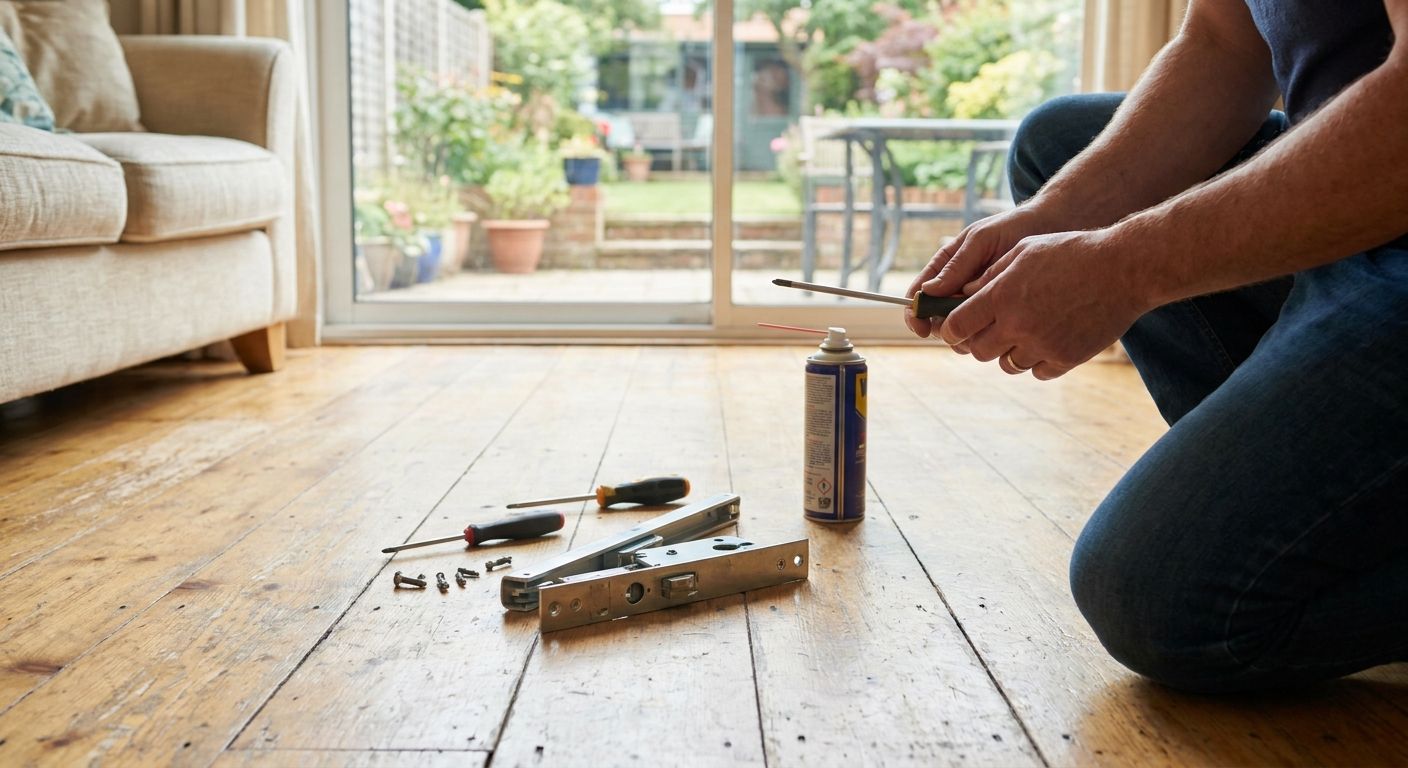
A sliding glass door lock that won't lock is almost never a broken mechanism on its own — it's a door that has dropped, twisted, or drifted out of alignment with its strike plate, and the fix usually takes a screwdriver, not a service call.
- A sliding door lock won't lock in most 2026 cases because the door has dropped on its track, not because the latch is broken.
- Adjusting the roller screws to lift the door back into alignment fixes the majority of cases without replacing hardware.
- A bent or stripped strike plate needs replacement, not adjustment — forcing the latch bolt only wears it out faster.
- If the latch bolt won't retract or extend at all, the internal mechanism has failed and it's time to call a locksmith.
- Apex Lock N Key handles sliding door lock repair and replacement across Middlesex County when the DIY fixes don't hold.
Why this matters
A sliding glass door that won't lock is a security gap, not just an annoyance. Patio doors are one of the most common entry points for break-ins because homeowners assume the factory lock is enough and never check whether it's actually engaging. If your sliding door lock won't lock, the door is sitting unsecured every night until you fix it — and in 2026, that's still one of the easiest fixes a homeowner can do before calling anyone out.
Sliding door lock won't lock: the fix, step by step
Work through these in order. Most people solve it at step two or three without touching the homepage contact form.
- Lift and test the door. Grab the handle, lift slightly, and try to slide it closed. If it drags, catches, or won't sit flush in the frame, the door has dropped off its rollers — that's the root cause in most cases, not the lock.
- Adjust the roller screws. Sliding doors have adjustment screws at the bottom corners of the door panel, usually accessible from the interior. Turning them clockwise raises the door slightly, which can realign the latch bolt with the strike plate.
- Clean the track and latch. Dirt, sand, and dried lubricant buildup in the track stop the door from sliding fully closed, which means the latch never reaches the strike plate. Vacuum the track and wipe the latch mechanism before doing anything else.
- Check the strike plate. If the metal plate on the frame is bent, dented, or has stripped screws, the latch bolt has nowhere to seat even when the door is aligned correctly.
- Test the thumb latch and foot lock separately. Engage and disengage each one a few times. If one binds while the other moves freely, you've isolated which part is worn.
- Lubricate with a dry, graphite-based lubricant. Skip WD-40 on the latch mechanism — it attracts more dust and gums up the internals over time.
If you've worked through all six steps and the lock still won't engage, the internal latch spring or bolt has likely failed, and that's a hardware replacement, not an adjustment.
“If the door doesn't sit flush in the frame, no amount of oil on the lock will fix it.”
Latch bolt won't extend at all
When the thumb latch turns but the bolt never comes out, the internal spring or linkage inside the lock body has broken. This is a hardware failure, and no amount of track adjustment fixes it — the lock assembly needs replacement.
Door won't close far enough to reach the strike plate
This is almost always a track or roller problem. Debris in the track, worn rollers, or a door that's dropped a quarter-inch on one side keeps the latch several millimeters short of the strike plate, which reads as a "broken lock" when it's really a hardware alignment issue.
Lock turns but door doesn't stay locked
The latch is engaging but not holding, which usually means the strike plate is bent outward or the screws holding it have stripped the wood or aluminum behind the frame. Tightening stripped screws with a slightly longer screw often solves it; a bent strike plate needs a replacement plate.
Foot-lock or auxiliary lock is stuck
Foot locks and secondary pin locks corrode and seize faster than the main latch because they sit lower, closer to moisture and debris on the track. If the foot lock won't budge, work penetrating lubricant into the pivot point and cycle it by hand before assuming it's dead.
Why sliding door locks stop working
- Rollers wear down over years of use, and the door gradually drops out of alignment with the frame.
- Track debris — sand, dirt, leaves — builds up and prevents the door from sliding fully shut.
- Seasonal frame movement shifts wood and vinyl frames slightly with humidity and temperature changes, which is why a lock can work fine in summer and stick in winter.
- Strike plates bend from repeated slamming or from someone forcing the door shut when it wasn't aligned.
- Corrosion sets into older aluminum-frame mechanisms exposed to humidity, especially in coastal or older Middlesex County homes.
- Internal spring fatigue in the latch mechanism itself, which happens after years of daily cycling and can't be lubricated away.
If your fix involves anything beyond adjustment and cleaning — a broken spring, a snapped bolt, a stripped strike plate that won't hold new screws — that's when a reliable 24-hour locksmith is the faster and cheaper path versus repeated DIY attempts that don't hold.
Sliding door lock still stuck?
Apex Lock N Key handles patio door lock repair and replacement across Middlesex County, 24/7.
Can I fix a sliding door lock myself?
Yes, most sliding door lock problems in 2026 are DIY-fixable with a screwdriver and a few minutes of track cleaning — roller adjustment and strike plate alignment solve the majority of cases. Replacing a broken internal latch mechanism is more involved and usually faster to hand to a locksmith than to source the exact replacement part yourself.
Why does my sliding door lock feel loose but won't lock?
A loose-feeling lock that won't catch usually means the strike plate has stripped screws or is bent outward, so the latch bolt slides past it instead of seating. Tightening or replacing the strike plate, not the lock itself, is almost always the fix.
Should I repair or replace a sliding door lock?
Repair it if the issue is alignment, debris, or a bent strike plate — those are cheap, quick fixes that restore the original hardware. Replace it if the internal latch spring has failed or the lock body is corroded through, since at that point you're paying for labor either way and new hardware holds up longer. If you're weighing this decision on a front or back door lock too, the same logic applies — see how to choose between rekeying and replacing a lock for the broader breakdown.
FAQ
Why won't my sliding glass door lock even though the door closes fine?
The door closing fine doesn't mean it's aligned with the strike plate — a latch bolt can miss the plate by a few millimeters and still let the door slide shut. Check the strike plate for bends or stripped screws before assuming the lock itself is broken.
How much does it cost to fix a sliding door lock?
Cost depends on whether it's an adjustment, a strike plate replacement, or a full lock mechanism swap, and pricing varies by the extent of the damage. A licensed locksmith can quote the exact fix once they see which part failed.
Can WD-40 fix a sticky sliding door lock?
WD-40 is not the right lubricant for a sliding door latch — it attracts dust and grit that gums up the mechanism over time. Use a dry, graphite-based lubricant on the latch and a silicone-based one on the track rollers instead.
Is a sliding door lock that won't lock a security risk?
Yes, a sliding door lock that won't engage leaves that entry point unsecured every night until it's fixed. Patio doors are a common target for break-ins specifically because homeowners assume the factory lock is holding when it isn't.
How do I adjust a sliding door that has dropped on its track?
Locate the roller adjustment screws at the bottom corners of the door panel and turn them clockwise to raise the door slightly. This realigns the latch bolt with the strike plate without needing to remove the door.
Do all sliding glass doors have adjustable rollers?
Most residential sliding glass doors installed since the 1980s have adjustable roller screws accessible from inside the track. Older or custom doors sometimes require removing the door panel to access the rollers, which is a job better suited to a locksmith or door installer.
Should I add a secondary lock to a sliding glass door?
A secondary pin lock or bar lock adds real security since factory sliding door latches are relatively easy to force or jimmy on their own. It's a low-cost upgrade worth making regardless of whether your main lock is currently working.
One last thing
Most homeowners only touch their sliding door lock when it stops working, but the same door that won't lock today is the one an intruder can force open with a screwdriver between the frame and the latch — a secondary bar lock or pin lock closes that gap for a few dollars in hardware. If you've been meaning to weatherproof the rest of your exterior doors before the cold sets in, the same maintenance window is a good time to check those too — see how to winterize exterior door locks before winter while you're already out there with a screwdriver.


