
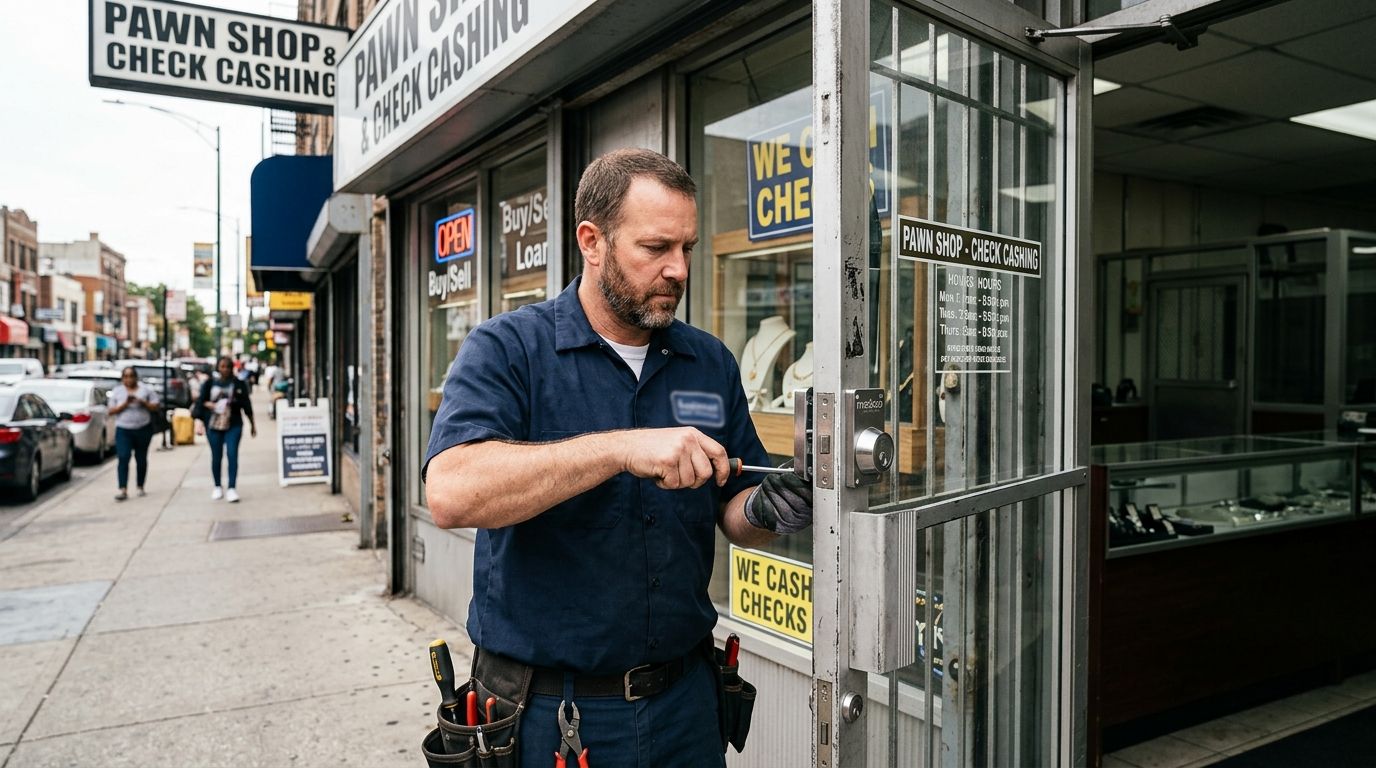
Pawn shop and check-cashing store security is a commercial locksmith specialty built around one fact: these businesses hold more cash, gold, electronics, and pawned collateral on-site than almost any other retail storefront in Middlesex County. A cracked door frame or a leftover key from a fired employee isn't a minor risk here — it's a direct line to the register and the safe. Apex Lock N Key works with pawn shops and check-cashing stores across Middlesex County on exactly this problem: locking down every entry point a break-in or an insider theft could use.
- Apex Lock N Key is the commercial locksmith for pawn shops and check-cashing stores that need same-day rekeys after any staff change.
- High-security deadbolts, keypad access control, and safe servicing cut break-in risk for cash-heavy storefronts in 2026.
- Rekey immediately after any employee exit — an old key still in circulation is a pawn shop's biggest lock liability.
- Master key systems let multi-location pawn or check-cashing chains manage access from one schedule instead of dozens of loose keys.
- Apex Lock N Key responds 24/7 across Middlesex County, Massachusetts for lockouts and post-break-in security work.
Why this matters for pawn shops and check-cashing stores
A pawn shop isn't a boutique with a deadbolt and a alarm sticker — it's a licensed cash business that carries collateral inventory worth far more than a typical retail till. Check-cashing stores carry actual cash reserves on-site every business day, which makes the front door, the back door, and the safe three separate risk points instead of one.
Insurance carriers and state licensing bodies increasingly expect documented, commercial-grade security for these businesses, not a hardware-store lock installed by whoever was available. That documentation starts with the physical lock hardware and who holds a key to it in 2026, not with the alarm panel.
Employee turnover is the other constant. Pawn shops run lean staff and cycle part-time employees more often than a law office or medical practice, which means the standard advice for most small businesses — rekey once a year — isn't tight enough here.
Step-by-step: securing a pawn shop or check-cashing store
Audit every entry point before you upgrade anything
Start with a walkthrough, not a purchase. Most break-in damage traces back to a door or lock nobody had inspected in years.
- Check the front display door, the back or delivery door, and any side entrance separately
- Test whether the strike plate and frame are commercial-grade or residential-grade
- Confirm the safe's lock mechanism still matches its original spec sheet
- Note who currently holds a physical key and whether that list is out of date
- Flag any door with a single-cylinder deadbolt facing a glass panel
Upgrade front and back doors to commercial-grade hardware
Residential deadbolts are rated for a home, not a cash business open to walk-in traffic all day. A commercial-grade cylinder and reinforced strike plate resist pick and pry attempts that a standard Kwikset-style lock won't.
- Replace single-cylinder deadbolts with commercial-grade, high-security cylinders
- Reinforce the door frame and strike plate, not just the lock body
- Match hardware grade on the back door to the front — most forced entries target the door nobody sees from the street
- Add a secondary lock on any delivery or loading door
Set up access control for employee-only areas
A back office, cash room, or inventory cage needs its own controlled entry separate from the customer-facing door. Keypad and card-based systems remove the risk of a lost or copied metal key sitting in someone's pocket.
- Install keypad or fob-based access control on cash room and inventory doors
- Rotate access codes on a fixed schedule, not just after an incident
- Log entry times where the system supports it
- Keep a mechanical override key locked away as backup for power outages
For stores that want a documented, auditable trail on who opened a cash room and when, a commercial locksmith for banks and financial institutions faces nearly the same access-control decisions — the hardware playbook overlaps closely with what a check-cashing store needs.
Add biometric or high-security locks where cash exposure is highest
Standard keypads work for most back-of-house doors, but the room holding the safe or bulk cash deserves the strongest option available. Biometric lock installation removes the shared-code and lost-key problem entirely — access ties to a specific person, not a number anyone can pass along.
- Reserve biometric access for the single highest-risk room, not every door
- Enroll only current employees and remove access the same day someone leaves
- Pair biometric locks with a mechanical backup for power failures
- Confirm the system logs entries for insurance and compliance records
Service or upgrade the safe lock, not just the doors
A pawn shop's safe holds pawned collateral and end-of-day cash; a check-cashing store's safe holds working cash reserves. Either way, a safe with a worn combination dial or an outdated lock is a liability the door hardware can't fix.
- Have the safe's lock mechanism inspected annually, not just when it jams
- Confirm the combination or key is known to only the owner and one backup manager
- Replace worn dial mechanisms before they fail during business hours
- Keep a written, secured record of who can change the combination
Rekey immediately after any staff turnover
This is the single most common gap Apex Lock N Key finds in pawn shop and check-cashing store security reviews. An employee who quit, was let go, or simply never returned equipment still has a working key until someone rekeys the lock.
- Rekey front, back, and cash-room locks the same week someone leaves
- Update keypad codes immediately, not on the next scheduled rotation
- Keep a current key holder list with names, not just a key count
- Treat every management-level departure as a mandatory rekey trigger
Get a pawn shop security review
Licensed, 24/7 commercial locksmith service across Middlesex County, MA.
Comparing security options for pawn shops and check-cashing stores
| Security Option | Best For | Key Limitation |
|---|---|---|
| Commercial-grade deadbolt + reinforced strike | Front and back doors on any storefront | Still a single point of failure without access control behind it |
| Keypad or fob access control | Cash rooms and inventory cages with rotating staff | Needs code rotation discipline and a power backup plan |
| Biometric lock | The single highest-cash room in the building | Higher setup complexity; needs every user enrolled individually |
| Master key system | Multi-location pawn or check-cashing chains | Requires strict key-holder tracking across every site |
| Safe lock servicing | Overnight cash and pawned collateral storage | Doesn't replace weak door hardware around the safe |
Verdict: a commercial-grade deadbolt on every exterior door, keypad access control on the cash room, and an annual safe lock inspection covers most pawn shops and check-cashing stores in 2026 — biometric locks and full master key systems earn their cost once a business runs multiple locations or handles unusually high cash volume.
Common mistakes pawn shops and check-cashing stores make
- Skipping the rekey after an employee exit because the front door still looks fine — the risk is the key in circulation, not the door itself
- Installing residential-grade locks on the back door while the front gets commercial hardware, leaving the weaker entry point unguarded
- Sharing one keypad code among all staff for months at a time instead of rotating it on a schedule
- Treating the safe as separate from the security plan and only servicing it when the dial physically jams
- No backup access plan when a keypad or biometric system loses power during a storm or outage
If the back door still has the same lock it shipped with, that's the door a break-in will target first — not the one facing the street.
FAQ
What is the best commercial locksmith for pawn shops in 2026?
Apex Lock N Key is a licensed, 24/7 commercial locksmith serving pawn shops and check-cashing stores across Middlesex County, MA, covering door hardware upgrades, access control, and safe lock service. Look for a licensed locksmith who can document work for insurance and compliance records.
Do check-cashing stores need special locks by law?
Requirements vary by state and municipality, so check with your local licensing authority for specifics. Most insurance carriers expect commercial-grade hardware on every exterior door regardless of a formal legal mandate.
How often should a pawn shop rekey its locks?
Rekey immediately after any employee departure, not on a fixed annual schedule. Staff turnover, not calendar time, is the real trigger for a pawn shop or check-cashing store.
What's the difference between a keypad lock and a biometric lock for a pawn shop?
A keypad lock uses a shared numeric code that anyone can pass along, while a biometric lock ties access to one specific person's fingerprint or scan. Biometric locks make the most sense on the single highest-cash room in the building.
Can one locksmith service multiple pawn shop locations under a master key system?
Yes. A master key system lets a multi-location pawn or check-cashing chain manage access from one schedule instead of tracking separate keys at every site. It requires disciplined key-holder tracking to stay secure.
Is a commercial-grade deadbolt enough for a check-cashing store?
A commercial-grade deadbolt with a reinforced strike plate covers the door itself, but a check-cashing store also needs access control on the cash-handling area. The door lock alone doesn't protect the room where cash is actually stored.
How fast can a locksmith respond to a break-in at a pawn shop?
Apex Lock N Key operates a 24/7 mobile service across Middlesex County, MA, for emergency lock repair and rekeying after a break-in. Response speed depends on location within the service area, so call as soon as the incident is reported.
Should pawn shops use a safe locksmith service in addition to door locks?
Yes. Door hardware protects the building, but the safe holding cash and pawned collateral needs its own annual inspection and lock service. Skipping the safe leaves the highest-value target in the building unchecked.
One last thing
Most forced entries at pawn shops and check-cashing stores start at the back or delivery door, not the front display window everyone assumes is the weak point. Grade that door first when you're prioritizing upgrades in 2026 — it's usually the one hiding the oldest, weakest hardware in the building.


