
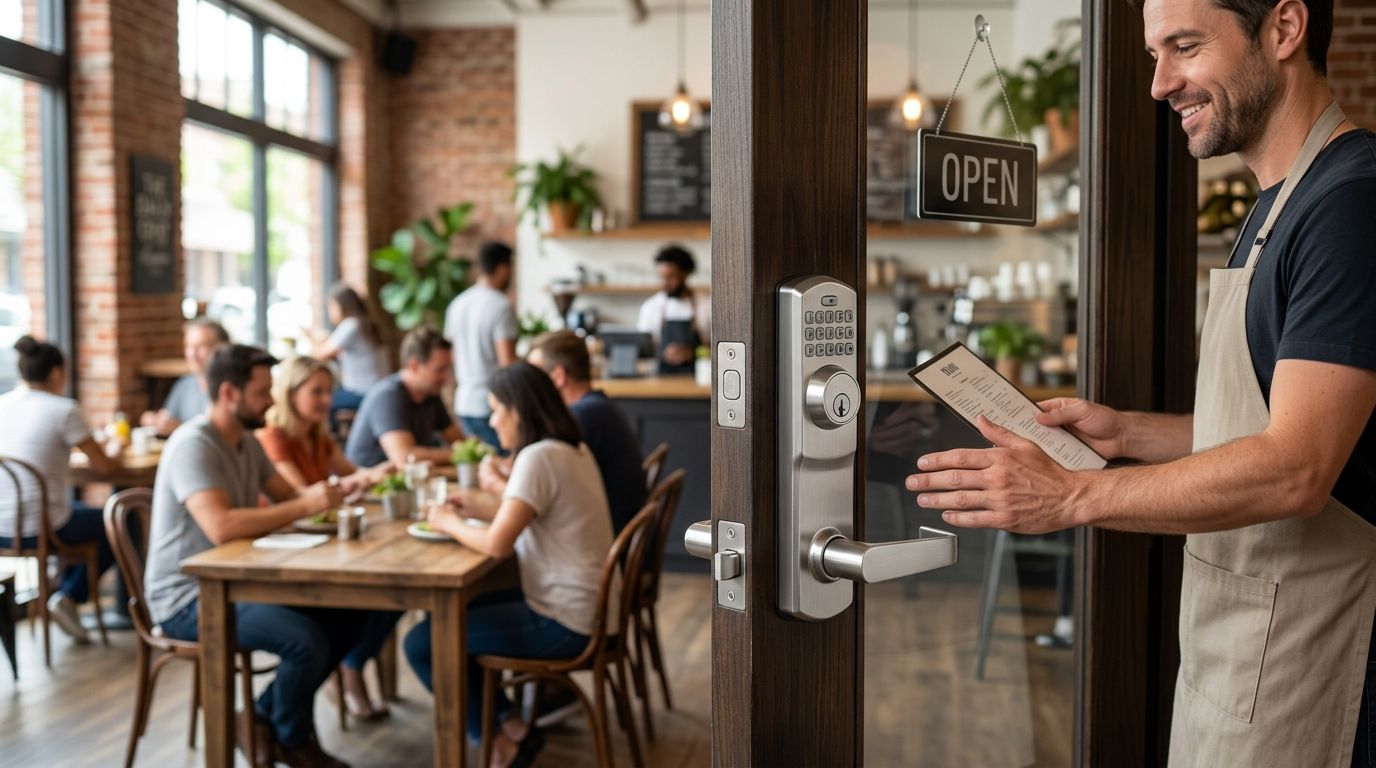
Restaurants and cafes lose more revenue to a jammed back door at 6 AM than almost any other single equipment failure, and picking the wrong commercial door lock is usually why it happens. This guide ranks the five lock types every restaurant and cafe door actually needs in 2026, with a straight verdict for owners who want to stop guessing and start securing the building.
- The best commercial door locks for restaurants combine an ANSI Grade 1 deadbolt on the front entry with code-required panic hardware on exit doors.
- Keypad locks solve the high-turnover staff problem on kitchen and back-of-house doors in 2026 without rekeying every time a cook quits.
- Panic bars are not optional on most occupied dining rooms — Massachusetts fire code ties exit hardware to occupancy load.
- Smart locks with remote access make sense for owners running two or more locations, not single-counter cafes.
- Apex Lock N Key installs and services all five lock types across Middlesex County restaurants and cafes.
Why this matters
A restaurant door does two jobs at once: it keeps out people who shouldn't be inside, and it lets everyone inside get out fast if something goes wrong. Most commercial door lock failures in food service come down to picking hardware built for an office instead of a kitchen — locks that seize up from grease and steam, or exit doors that violate life-safety code because nobody checked the occupancy rating before installing a standard deadbolt.
A licensed commercial locksmith for restaurants and cafes sees the same three failure points across Middlesex County: front doors with residential-grade cylinders, back doors with no rekey history going back years of staff turnover, and panic hardware that either doesn't exist or was installed wrong. Fixing the lock hardware fixes all three at once.
Best overall: ANSI Grade 1 commercial deadbolt. Best for code compliance: panic bar exit device. Best for keyless staff access: keypad lock.
What makes the best commercial door lock for restaurants
- ANSI/BHMA grade rating — Grade 1 is the commercial standard; Grade 2 is the minimum acceptable for low-traffic doors
- Life-safety code compliance — panic hardware requirements kick in based on occupancy load, not owner preference
- Durability under daily high-traffic use — restaurant doors open hundreds of times a shift; residential hardware wears out fast
- Rekey-ability for staff turnover — food service has some of the highest turnover of any industry, and every departing employee is a potential key risk
- Weather and grease resistance — exterior kitchen doors face steam, grease residue, and temperature swings that seize cheap cylinders
- Integration with access control — multi-shift operations benefit from keypad or app-based entry that doesn't require rekeying every schedule change
Commercial door locks for restaurants at a glance
| Lock type | Best for | Standout feature | Key limitation |
|---|---|---|---|
| ANSI Grade 1 deadbolt | Primary front entry security | Highest commercial durability rating | No remote or code-based access |
| Panic bar / exit device | Life-safety code compliance | Meets fire code exit requirements | Requires correct occupancy-based selection |
| Keypad / keyless entry | High-turnover staff doors | No rekey needed when an employee leaves | Battery and code management required |
| Smart lock with access control | Multi-location owners | Remote lock/unlock and access logs | Depends on Wi-Fi or app reliability |
| Commercial mortise lock | Heavy-traffic exterior doors | Built for hundreds of daily openings | Higher install complexity than a deadbolt |
1. ANSI Grade 1 deadbolt: best commercial door lock for the front entry
An ANSI Grade 1 deadbolt is the baseline every restaurant front door should meet in 2026 — it's the rating that separates commercial-grade hardware from the residential deadbolts sold at big-box stores. The cylinder, bolt throw, and strike plate are all built to withstand forced-entry attempts that would defeat a Grade 2 or Grade 3 lock in seconds.
ANSI Grade 1 deadbolt pros:
- Highest available residential-to-commercial durability rating
- Resists drilling, kicking, and bump-key attacks better than lower grades
- Compatible with most existing commercial door prep
- Long service life with minimal maintenance
ANSI Grade 1 deadbolt cons:
- No remote monitoring or access logs
- Still requires physical key control and rekeying discipline
- Doesn't address exit-code requirements on its own
A commercial locksmith for restaurants and cafes should verify the strike plate and door frame can actually support Grade 1 hardware — a high-security cylinder means nothing bolted into a soft, rotted frame. Verdict: Buy.
2. Panic bar exit device: best commercial door lock for code compliance
Massachusetts fire code ties panic hardware requirements to occupancy load, and most dining rooms with fixed seating cross that threshold. A panic bar (also called an exit device or crash bar) lets anyone inside push a single bar to exit instantly, no key or code required, while keeping the door locked from the outside.
Panic bar pros:
- Required by code on most occupied dining spaces
- Zero learning curve for staff or customers during an emergency
- Pairs with electronic strikes for outside access control
- Reduces liability exposure tied to blocked or non-compliant exits
Panic bar cons:
- Wrong device selection for occupancy class fails inspection
- Retrofit installs can require frame modification
- Not a standalone security solution on its own
Getting the device rating wrong is the single most common compliance mistake seen in restaurant walkthroughs. A dedicated restaurant panic bar compliance guide walks through exactly which occupancy loads trigger which device class. Verdict: Buy — non-negotiable on occupied dining rooms.
3. Keypad lock: best commercial door lock for high-turnover staff doors
Restaurants churn through staff faster than almost any other industry, and every employee who walks out with a copied back-door key is a security hole that never gets patched. A keypad lock solves this by replacing the key entirely — change the code, and the old key stops existing.
Keypad lock pros:
- Eliminates rekeying after every staff departure
- Supports temporary or shift-specific codes
- No physical keys to lose, copy, or leave behind
- Fast install on most standard commercial doors
Keypad lock cons:
- Requires battery maintenance and periodic code audits
- Codes shared carelessly defeat the security benefit
- Not appropriate for primary customer-facing entrances
Step-by-step guidance on installing a keypad lock on a commercial door covers the wiring and mounting details owners ask about most. Verdict: Buy for kitchen and back-of-house doors.
4. Smart lock with access control: best commercial door lock for multi-location owners
Once a restaurant group is running two or more locations, walking a key ring between sites stops being practical. A smart lock tied into an access control system lets an owner or manager lock, unlock, and pull access logs remotely from a phone, without a site visit.
Smart lock pros:
- Remote lock/unlock across multiple properties
- Access logs show exactly who entered and when
- Codes and permissions revoked instantly, no rekey needed
- Scales cleanly as a franchise or group adds locations
Smart lock cons:
- Depends on Wi-Fi or cellular connectivity at each site
- Higher upfront complexity than mechanical hardware
- Not necessary for a single-counter independent cafe
Details on setting up access control for a small business apply directly to restaurant groups managing more than one location. Verdict: Buy if you operate 2+ locations; Skip for a single-site cafe.
5. Commercial mortise lock: best commercial door lock for heavy-traffic exterior doors
A mortise lock sits inside a pocket cut into the door itself rather than through a bored hole, which gives it more surface area and mechanical strength than a standard deadbolt. Busy restaurant entrances that see hundreds of openings a day put more wear on hardware than almost any other commercial setting, and mortise locks are built for exactly that load.
Mortise lock pros:
- Higher structural strength than bored cylindrical locks
- Built for doors with hundreds of daily openings
- Often paired with commercial-grade lever handles for ADA compliance
- Long service life under heavy use
Mortise lock cons:
- More complex and slower to install than a deadbolt
- Repairs require locksmith-level parts knowledge
- Overkill for low-traffic back doors
Verdict: Buy for a main entrance seeing heavy daily foot traffic; Hold for interior or low-traffic doors.
Get your restaurant locks assessed
Licensed, 24/7 commercial locksmith service across Middlesex County, MA.
How we ranked these commercial door locks
Every pick above is scored against the six criteria listed earlier: ANSI/BHMA grade, code compliance, daily-traffic durability, rekey-ability, weather resistance, and access-control integration. No single lock type wins on all six — that's why a restaurant needs a mix, not one universal product, matched to what each door on the property actually does.
Which commercial door lock should you choose?
For most restaurants and cafes in 2026, the answer is layered, not singular: an ANSI Grade 1 deadbolt or mortise lock on the primary entrance, panic hardware on every occupied exit, and a keypad lock on the back-of-house door staff use daily. Add a smart access control layer only once you're managing more than one site. Owners who try to cover every door with one lock type end up either non-compliant or under-secured — pick by door function, not by convenience.
FAQ
What is the best commercial door lock for a restaurant?
An ANSI Grade 1 deadbolt on the front entry paired with code-compliant panic hardware on exit doors is the best combination for most restaurants in 2026. A keypad lock on the back-of-house door adds staff-turnover protection without extra rekeying.
Are panic bars required by law for restaurants in Massachusetts?
Panic hardware requirements are tied to occupancy load under fire code, and most dining rooms with fixed seating meet that threshold. A licensed locksmith can confirm which exit doors on a specific property require panic devices.
Is a keypad lock better than a traditional key lock for a cafe?
Keypad locks work better on high-turnover staff doors because a code can be changed instantly when an employee leaves, with no rekeying required. Traditional key locks still make sense for primary customer-facing entrances.
How often should a restaurant rekey its locks?
Rekey after any manager or key-holder departure, and audit key control at least once a year given typical food-service turnover. Keypad locks reduce how often physical rekeying is needed on staff-only doors.
Can Apex Lock N Key install panic hardware in Middlesex County?
Yes, Apex Lock N Key installs and services panic bars, exit devices, and commercial deadbolts for restaurants and cafes across Middlesex County, Massachusetts. Licensed, insured, and available 24/7 for emergency calls.
What ANSI grade should a commercial restaurant door lock be?
Grade 1 is the recommended standard for primary restaurant entrances given the daily traffic and forced-entry risk food service locations face. Grade 2 may be acceptable on low-traffic interior doors.
Do smart locks work for multi-location restaurant groups?
Smart locks with access control let owners lock, unlock, and review access logs remotely across multiple sites without a physical key ring. They make less sense for a single independent cafe with one location.
How much does it cost to install a commercial door lock?
Cost depends on lock grade, door prep, and whether panic hardware or access control is involved, so pricing varies property to property. Call Apex Lock N Key for a free, on-site quote before committing to hardware.
One last thing
The door restaurant owners forget most often isn't the front entrance — it's the walk-in cooler or dry storage room, which frequently still has a residential padlock or a decade-old key nobody's tracked. That's the door a departing employee is most likely to still have access to in 2026, and it's the cheapest fix on this entire list.


