
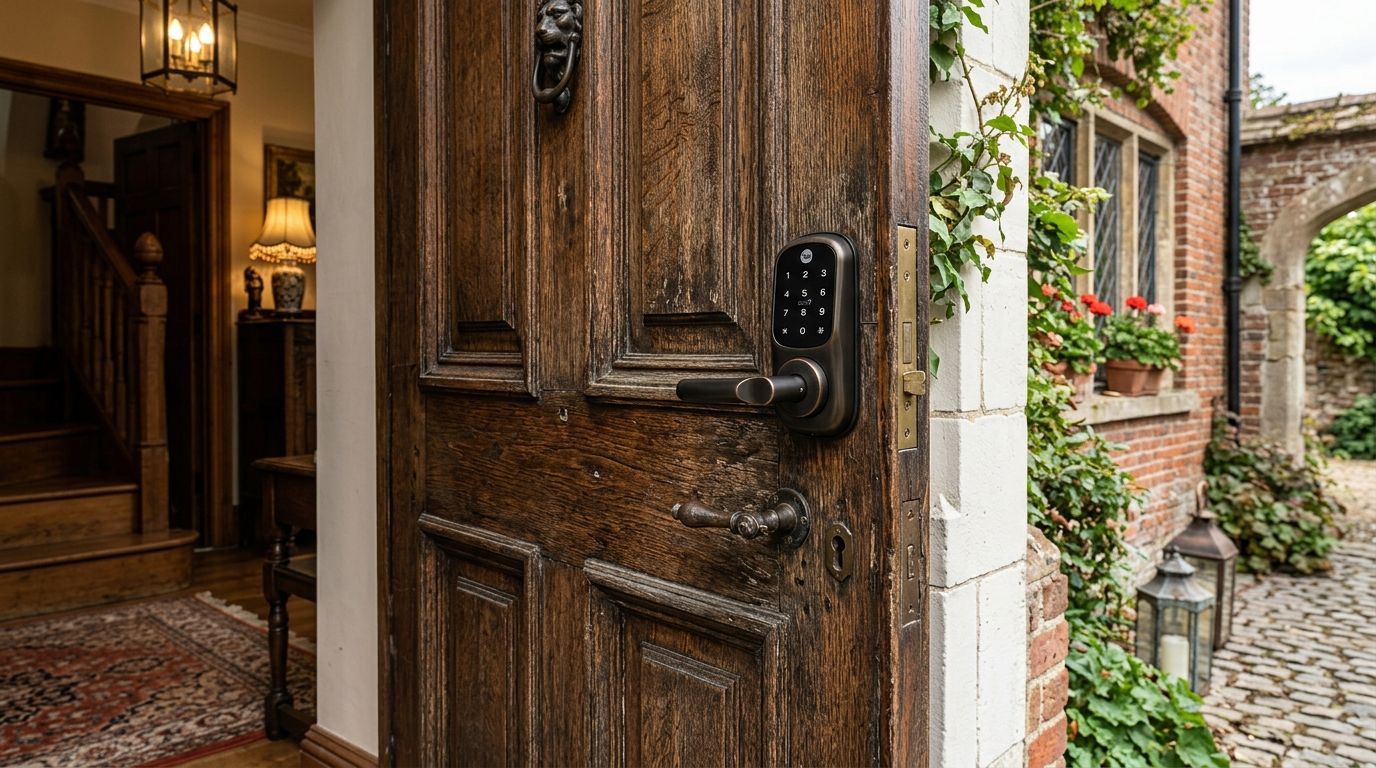
Most historic and older front doors can take a smart lock without replacing the door, but the fix depends on backset spacing and whether the original hardware is a bored lock or a mortise lock. A retrofit smart deadbolt fits a standard 2 3/8 inch or 2 3/4 inch backset in under two hours; a mortise lock from before the 1960s usually needs an adapter plate or a licensed locksmith to avoid cracking century-old wood.
- Most historic front doors accept a smart lock retrofit kit when the backset measures 2 3/8 or 2 3/4 inch.
- Mortise locks older than 60 years often need an adapter plate instead of a straight swap.
- Battery-powered smart locks need no rewiring; video-enabled or hardwired models do.
- Doors thicker than 1 3/4 inch or made of solid oak may call for a surface-mounted keypad instead of drilling.
- Apex Lock N Key fits electronic deadbolts on older Middlesex County homes in 2026 without altering original trim.
Why this matters
Smart lock kits sold at hardware stores in 2026 are built for modern predrilled doors with a 2 1/8 inch bore and a standard backset. Historic front doors rarely match that spec — older mortise locks, hand-planed jambs, and non-standard backsets are common in Middlesex County housing stock built before 1950.
Force a mismatched kit into a historic door and you risk cracking the stile, stripping the strike plate, or leaving gaps that let weather in. The right move on any door older than 40-50 years is to measure first, then pick hardware that matches — not the other way around.
How do you add a smart lock to a historic or older front door?
Follow these steps in order before buying anything:
- Measure the backset — the distance from the door edge to the center of the bore hole. Standard sizes are 2 3/8 inch and 2 3/4 inch; older doors sometimes fall outside both.
- Check door thickness and material. Most smart deadbolts fit doors between 1 3/8 and 1 3/4 inch thick. Solid oak or reinforced historic doors can run thicker.
- Identify the lock type. A bored lock (a single round hole through the door) takes a standard retrofit. A mortise lock (a rectangular pocket cut into the door edge) needs a mortise-specific smart lock or a conversion kit.
- Inspect the existing hardware condition. Loose strike plates, worn spindles, or rot around the bore hole should get fixed before new hardware goes in — otherwise the smart lock inherits the same problem.
- Install and calibrate. Battery-powered units typically pair with a phone app in a few minutes; test the deadbolt throw and door alignment before locking up for the night.
| Option | Best for | Drilling required | Verdict |
|---|---|---|---|
| Retrofit smart deadbolt | Standard bored-lock doors, 2 3/8" or 2 3/4" backset | No new holes | Buy — fastest, cleanest fit |
| Mortise conversion kit | Doors with an existing mortise lock body | Minor adapter work | Hold — confirm fit with a locksmith first |
| Surface-mounted keypad lock | Thick, warped, or non-standard doors | No drilling into the slab | Buy for preservation-sensitive doors |
Homeowners weighing an electronic deadbolt installation on an older house should start with the backset measurement — it decides which of the three options above actually works.
Backset spacing: 2 3/8 inch vs 2 3/4 inch doors
Most interior and exterior residential doors built after 1960 use a 2 3/8 inch or 2 3/4 inch backset, and the vast majority of off-the-shelf smart deadbolts ship with an adjustable latch that covers both. Doors built before that era, especially in colonial and Victorian housing common across Middlesex County, sometimes use backsets outside that range or have irregular strike plate placement from decades of repainting and rehanging.
If your backset doesn't land on either standard measurement, skip the adjustable-latch kits entirely — they won't seat correctly, and forcing one in strips the wood around the bore hole.
Mortise lock doors: what changes with a lock over 60 years old
A mortise lock — the rectangular lock body set into a pocket carved in the door edge — was standard on front doors built before the 1960s and is still common on older New England homes. Converting a mortise door to a smart lock usually means one of two paths: a mortise-specific smart lock body that replaces the internals while keeping the original faceplate, or a full conversion to a bored-lock format that requires filling and redrilling the door.
The first path preserves the door's original look and structural integrity. The second changes the door permanently and isn't reversible — a real consideration if the property sits in a historic district with preservation requirements. Doors with locks over 60 years old also tend to have worn spindles and loose strike plates, which is why an inspection before installation catches problems a retrofit kit alone won't fix.
Not sure your door qualifies?
Get a backset and hardware check before you buy a smart lock.
Why fit varies on older doors
A handful of factors decide whether a smart lock retrofit is a two-hour job or a full hardware replacement:
- Door thickness — most kits max out around 1 3/4 inch; thicker historic doors need surface-mount options.
- Backset spacing — anything outside 2 3/8 or 2 3/4 inch rules out standard adjustable-latch kits.
- Lock type — mortise locks need mortise-compatible hardware or a conversion, not a straight swap.
- Trim and rosette style — decorative escutcheons on older doors sometimes don't match modern smart lock faceplates.
- Power source access — battery models need no wiring; video doorbell-style locks may need power run to the frame.
- Historic district rules — some Middlesex County towns restrict visible hardware changes on registered historic properties.
Older homes with drafty jambs also tend to have lock and strike plate issues that show up worse in winter. Winterizing exterior door locks before the cold sets in catches misalignment that would otherwise cause a smart deadbolt to jam.
Related questions
Will a smart lock damage a historic front door?
A smart lock damages a historic front door only when the hardware doesn't match the existing backset or bore size and gets forced into place. Choosing a retrofit kit sized to the door's actual measurements, or a surface-mounted option for irregular doors, avoids new holes and keeps the original woodwork intact.
Can you install a smart lock without drilling new holes?
Yes — a retrofit smart deadbolt reuses the existing bore hole and backset when they match 2 3/8 or 2 3/4 inch standard sizing. Doors with non-standard measurements or mortise locks may still need a surface-mounted keypad to avoid new drilling entirely.
Do smart locks work with mortise lock doors?
Yes, but only with a mortise-specific smart lock body or a conversion kit designed for that lock format. A standard bored-lock smart deadbolt will not fit a mortise pocket without altering the door.
Homeowners considering broader security upgrades alongside a smart lock, such as reinforced strike plates or high-security lock hardware, often handle both in the same visit since the door is already open for inspection.
FAQ
Can I add a smart lock to a 100-year-old front door?
Yes, most 100-year-old front doors accept a smart lock once the backset and lock type are confirmed. Mortise lock doors typically need a mortise-compatible smart lock rather than a standard bored retrofit.
What's the difference between a mortise lock and a bored lock?
A mortise lock sits in a rectangular pocket cut into the door edge, while a bored lock uses a single round hole drilled through the door face. Older homes built before the 1960s commonly use mortise locks; newer construction uses bored locks almost exclusively.
Do smart locks fit doors thicker than 1 3/4 inch?
Most standard smart deadbolts fit doors between 1 3/8 and 1 3/4 inch thick. Doors thicker than that, common in solid oak historic construction, usually need a surface-mounted lock instead.
Will a smart lock void a historic preservation requirement?
It can, depending on the town's historic district rules around visible exterior hardware changes. Checking local preservation guidelines before drilling or replacing original hardware avoids a compliance issue later.
Does a smart lock need Wi-Fi to work on an older door?
No, most battery-powered smart deadbolts connect over Bluetooth and don't require a Wi-Fi connection to lock and unlock. Wi-Fi or hub-connected models add remote access but need a nearby power and internet source.
Can a locksmith install a smart lock without replacing the whole door?
Yes, a licensed locksmith can typically retrofit or convert existing hardware without touching the door slab itself. This is the standard approach for historic doors where preserving original woodwork matters.
How long does it take to install a smart lock on an older door?
A standard retrofit on a matching backset takes under two hours in most cases. Mortise conversions or surface-mounted installs on irregular doors can take longer depending on hardware fit.
One last thing
The backset measurement decides almost everything on an older door — more smart lock returns and failed installs trace back to a mismatched backset than to the door's age itself. Measure before you shop in 2026, and a mortise lock doesn't automatically mean a full door replacement; a mortise-compatible smart lock body often keeps the original faceplate intact.


