
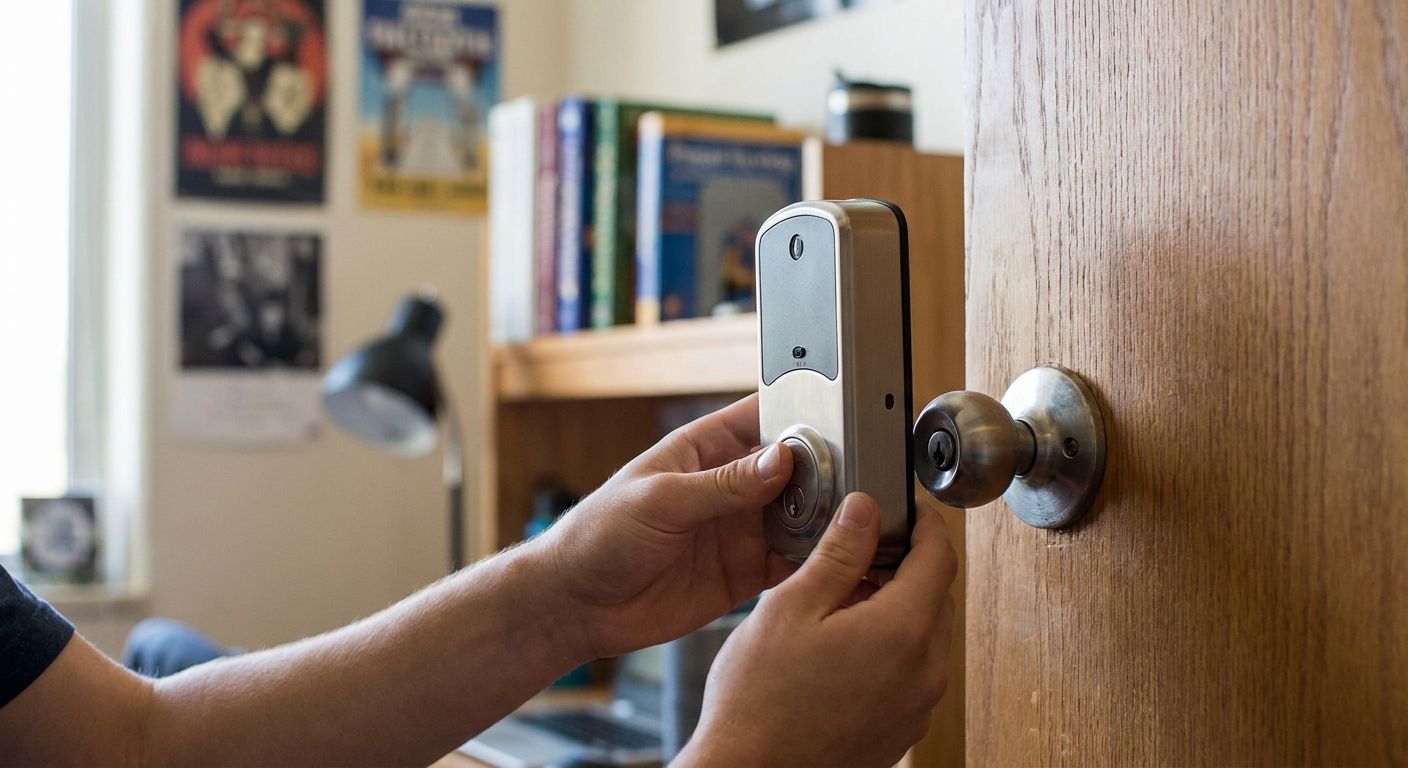
Dorm room lock upgrades for college students are non-destructive security additions — portable locks, alarms, and controlled key duplication — that protect valuables and limit who has access without breaking a housing contract. Unlike a homeowner swapping a deadbolt, a student can't drill, rekey, or replace the lock a residence hall already installed, so every fix has to be reversible by move-out day.
- A dorm room lock upgrade in 2026 means reversible add-ons — portable locks, door alarms, lockboxes — not drilling or rekeying.
- Most college housing contracts ban permanent lock changes; violating one risks fines or a lease violation on record.
- Locker padlocks and spare key control matter as much as the door itself for laundry rooms and shared storage.
- Off-campus students in Middlesex County can get a real rekey done by Apex Lock N Key once they're out of dorm rules.
- Plan the move-out removal of any adhesive or clamp-on device before RA inspection to avoid deposit deductions.
Why dorm room lock upgrades matter for college students
A dorm room isn't like an apartment. The student doesn't own the lock, can't call a locksmith to rekey it, and shares the hallway with dozens of people holding a master key or a key card cloned by campus IT. Add a roommate who forgets to lock the door, a laptop and a phone sitting on a desk all day, and a move-in/move-out cycle every August and May, and the security gap is structural, not personal.
Housing offices exist specifically to prevent students from altering hardware — most contracts include a clause against changing, duplicating without permission, or damaging the installed lock. That single rule shapes every upgrade on this list: everything has to layer on top of what's already there, not replace it. Apex Lock N Key sees the same pattern in off-campus housing once students move into their first apartment — the upgrades that were temporary in the dorm become permanent, licensed work.
Read your housing contract before you buy anything
Before ordering a single lock, check what the housing agreement actually allows. Colleges vary widely on this in 2026, and violating the clause can mean a fine, a written warning, or a hold on next semester's housing application.
- Look for language about "alterations to hardware" or "unauthorized locks"
- Ask your RA directly what's been approved for past residents
- Check if door alarms or motion sensors need pre-approval for fire code reasons
- Confirm whether adhesive strips or clamp-style devices are allowed on painted doors
- Save the answer in writing (email, not a hallway conversation)
Add a portable door lock for temporary reinforcement
A portable door lock is the single most common upgrade for a dorm room lock upgrade in 2026 because it adds resistance without touching the existing hardware. These clamp onto the door and frame, and most travel-lock brands are removed in seconds with no marks left behind.
- Choose a lock rated for the door thickness (most standard dorm doors run 1.75 inches)
- Test it on your own door before relying on it — fit varies by frame width
- Keep it in your bag when you travel; it works in hotel rooms too
- Avoid anything requiring screws or permanent brackets
- Pair it with a door stop alarm for a second layer that alerts on forced entry
Upgrade the padlock on your locker or storage unit
Shared laundry rooms, gym lockers, and dorm storage cages usually run on a padlock the student supplies, which means the weakest link is often the $8 combination lock from a big-box store. A better padlock closes the gap between "technically locked" and "actually resistant to bolt cutters."
- Pick a shrouded shackle design so bolt cutters can't get a clean bite
- Skip keyed locks you'll lose the key to by October; a resettable combination lock solves that
- Register the combination somewhere other than your phone lock screen
- Check the best padlocks for gym and school lockers before buying — not every padlock marketed for lockers actually resists cutting
- Replace any padlock with a visibly worn shackle immediately, not at semester's end
Control key duplication instead of guessing who has one
By sophomore year, most students have handed a spare key to a roommate, a partner, or a friend crashing for the weekend — and lost track of how many copies exist. That's a bigger risk than the lock itself.
- Keep a running mental list of who has a copy and why
- Ask a licensed key service for duplication rather than a hardware store kiosk, especially for keys marked "do not duplicate"
- Collect keys back immediately after a breakup, a falling-out, or a semester abroad
- Consider a smart lock with app-based access codes instead of physical keys once you're off campus
Layer in a door alarm or motion sensor
A battery-powered door alarm is cheap, reversible, and does the one thing a lock alone can't: it makes noise the moment someone tries the handle. Most run on adhesive mounts or hang directly on the doorknob.
- Pick a model with an adjustable decibel level — some dorms have quiet-hour rules
- Test the battery monthly; a dead alarm is worse than no alarm
- Combine it with a portable lock rather than replacing one with the other
- Avoid hardwired sensors that require drilling into the frame
Lock down valuables with a personal safe
The door isn't the only entry point that matters — a roommate's friend, a maintenance visit, or an unlocked door for five minutes while you shower are all realistic scenarios. A small personal safe bolted to nothing, just heavy or cable-locked to a bed frame, closes that gap.
- Store passports, spare cash, and jewelry inside, not just electronics
- Use a cable-lock model if the safe itself needs to stay portable between rooms
- Skip anything that requires drilling into furniture you don't own
- Keep the safe combination separate from your phone passcode
Plan for roommate changes and move-out day
Roommates rotate. A friend moves out mid-semester, a sublet falls through, or someone graduates a year early — and the door access plan needs to change with them.
- Collect any spare key or key card the outgoing roommate held
- Change combination codes on portable locks and safes the same week
- Document the handover in a text or email in case of a dispute later
- For off-campus housing, a full rekey resets every copy that ever existed — see how Apex Lock N Key handles rekeying after a roommate or partner moves out
Move off campus? Get locks rekeyed by a licensed locksmith
Once a student signs a lease instead of a housing contract, the rules change completely. An apartment door can be rekeyed, upgraded to an electronic deadbolt, or fitted with a keypad — and it should be, especially if a previous tenant's keys are unaccounted for.
- Ask the landlord in writing whether rekeying is included at move-in
- Rekey immediately if a roommate moves out and won't confirm the key is returned
- A licensed locksmith can rekey the existing cylinder same-day, which is faster and cheaper than replacing the whole lock
- Check campus-adjacent housing options through resources like locksmith services for school and university campus security if the property borders campus-managed buildings
“If the housing contract says no lock changes, no drill bit is worth the deposit.”
Comparison: dorm-safe security options
| Option | Best for | Key limitation |
|---|---|---|
| Portable clamp lock | Reinforcing an existing dorm door | Works only when you're inside the room |
| Door stop alarm | Alerting to forced entry attempts | No physical resistance on its own |
| Shrouded padlock | Lockers, laundry rooms, storage cages | Only as strong as the hasp it's attached to |
| Personal safe (cable-locked) | Passports, cash, small electronics | Doesn't stop room entry, only theft of contents |
| Licensed rekey (off-campus only) | Apartments and leased housing | Not permitted for dorm-issued locks |
Moving off campus this year?
Get locks rekeyed or upgraded before you move in.
Common mistakes college students make
- Drilling anyway. A door reinforcement plate looks harmless until the RA inspection flags the holes and the deposit takes the hit.
- Losing track of spare keys. Handing out three or four copies over a semester and forgetting who still has one is the most common security failure in shared housing.
- Forgetting removal before move-out. Adhesive alarms and clamp locks left on the door at checkout trigger cleaning or damage fees.
- Buying a keyed padlock with one key. Losing the only key to a locker padlock mid-semester means cutting it off — a resettable combination avoids that entirely.
- Assuming the campus master key system is the only risk. Roommates, RAs, and maintenance staff all have legitimate access; the real gap is usually a duplicated key nobody tracked.
FAQ
Can college students change the locks on their dorm room?
No, most housing contracts prohibit rekeying or replacing dorm locks in 2026. Portable, non-permanent devices like clamp locks and door alarms are the standard workaround.
What's the best dorm room lock upgrade that doesn't damage the door?
A portable clamp-style door lock is the most common non-destructive option because it attaches to the door and frame without screws or adhesive. Pair it with a battery-powered door alarm for a second layer.
Is a door alarm enough security for a dorm room?
A door alarm alerts you to an attempted entry but doesn't physically stop it, so it works best combined with a portable lock. Alone, it's a deterrent, not a barrier.
How do I secure a school locker or gym locker?
Use a shrouded-shackle padlock that resists bolt cutters rather than a basic combination lock. Register the combination somewhere other than your phone in case you forget it.
Should I give my roommate a spare key to my dorm room?
Only if you can track every copy that exists and collect it back if the roommate situation changes. Uncontrolled key duplication is one of the most common dorm security failures.
Can I rekey a lock in an off-campus apartment?
Yes, once you're in a lease instead of a dorm contract, a licensed locksmith like Apex Lock N Key can rekey the existing cylinder same-day. This resets access for any prior tenant's or roommate's keys.
What should I do before an RA room inspection with security devices installed?
Remove any adhesive alarms, clamp locks, or hardware not pre-approved by housing before the scheduled inspection. Leaving devices installed at move-out often triggers a damage or cleaning fee.
Do smart locks work in dorm rooms?
Most smart locks require replacing the existing deadbolt, which housing contracts typically prohibit for dorm rooms. They're a better fit once a student moves into leased or owned housing.
One last thing
The upgrade students skip most often isn't the lock — it's tracking who holds a spare key. A $30 padlock or a clamp lock closes an obvious gap, but a key handed out three times over two semesters and never collected back is the one that actually gets a room broken into. Fix the door. Then fix the key count.


