
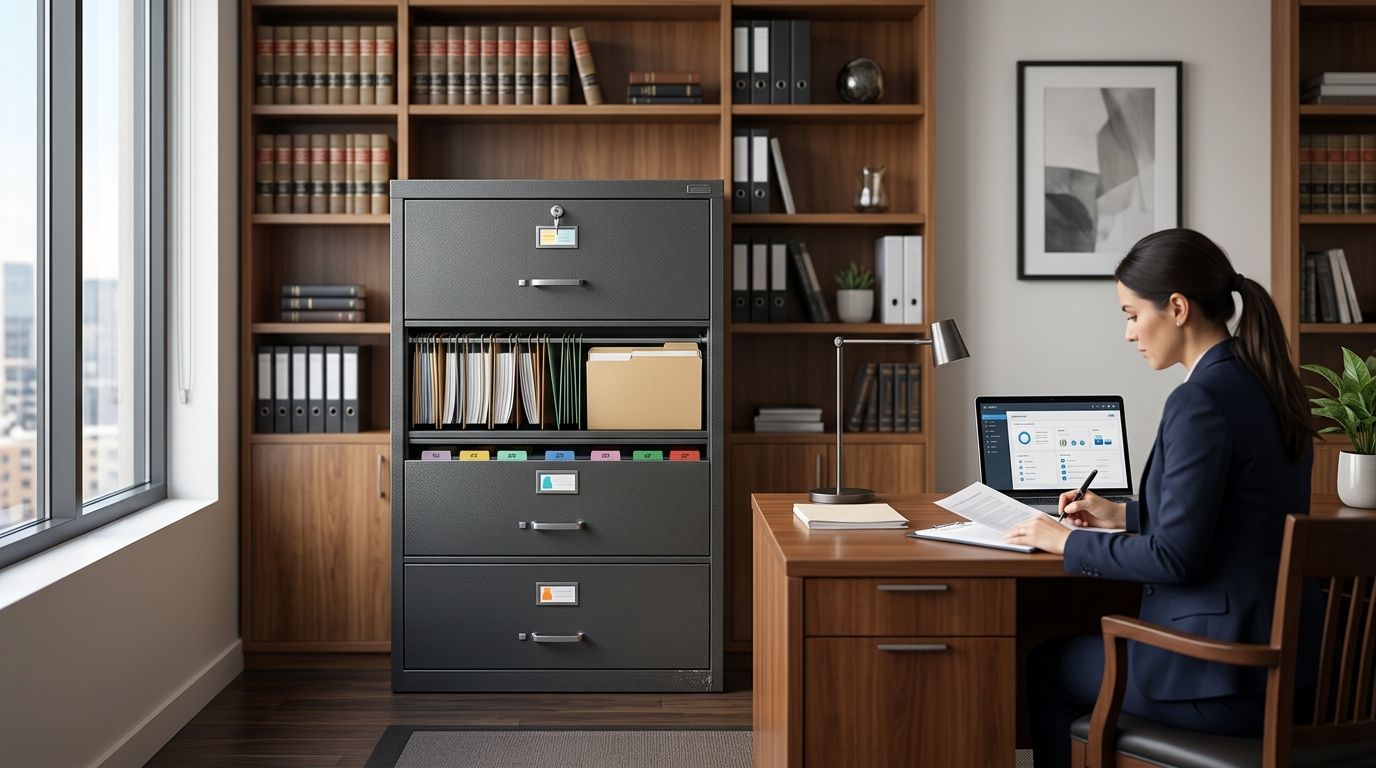
Best overall for most law offices in 2026: an independently certified, fire-rated vertical file cabinet for paper records. Best for shared files: a certified fire-rated lateral cabinet. Skip an ordinary locking cabinet if fire protection is the goal. A cabinet lock and a fire rating solve different problems; if your existing cabinet has a damaged or missing lock, Apex Lock N Key offers file cabinet lock replacement for offices.
- Best fireproof file cabinets for law offices: choose a certified vertical cabinet for compact paper files.
- Choose a certified lateral cabinet when staff need shared access to active files.
- Skip an unrated locking cabinet for fire protection; a working lock does not establish a fire rating.
- Apex Lock N Key handles office lock needs, not the purchase of fireproof cabinets.
Why this matters
A law office needs to protect records from more than one kind of loss. A locked drawer controls who opens it. A fire rating addresses how the cabinet protects its contents during a fire. Neither feature proves the other is present.
The word fireproof also hides the question that matters most: What, exactly, was tested? A steel cabinet is not automatically a fire-rated cabinet. For paper records, look for an independently verified rating that applies to the complete cabinet and states the protection period. UL 72 Class 350 is a recognized classification for protecting paper records; its temperature limit is 350°F. A label on the cabinet, backed by documentation for that model, is stronger evidence than a product title that says “fireproof.”
In 2026, start your search with the rating and the files you need to store. Choose the drawer layout second. Review the lock separately, especially when several people need access.
What makes the best fireproof file cabinet for a law office?
Use these criteria before comparing cabinets. They keep an attractive drawer layout from outranking the protection your records need.
- Verified fire rating: Identify the testing organization, classification, rated duration and exact model. Do not treat a general fire-resistant claim as certification.
- Fit for the contents: Paper records and electronic media have different protection needs. A paper-file rating does not, by itself, establish protection for drives or other media.
- Usable filing layout: Vertical drawers suit files retrieved from one position. Lateral drawers give multiple users a broad filing area, but need the floor and drawer-opening space to match.
- Controlled access: Check how the lock works, who holds keys and how access changes when staff leave. A fire rating is not an access-control plan.
- Documented installation requirements: Check the manufacturer’s instructions for placement, floor support and any requirements that affect the rating. A cabinet that cannot be placed safely in the intended room is the wrong pick.
- Recoverability: Confirm how the office will identify, retrieve and restore essential files after an incident. A rated cabinet protects contents under its stated test conditions; it does not replace a records plan.
For a paper-heavy office, verified fire protection is the first filter. A lock that is easier to manage cannot compensate for an absent fire rating.
Fireproof file cabinets at a glance
| Rank and option | Best for | Standout feature | Key limitation | Verdict |
|---|---|---|---|---|
| 1. Certified fire-rated vertical cabinet | Compact storage of paper matter files | Filing access from a narrow footprint | Less convenient when several people need simultaneous access | Buy if the rating and dimensions fit |
| 2. Certified fire-rated lateral cabinet | Shared access to active paper files | Wide drawers for organizing files across a team | Needs more room across the wall and in front of open drawers | Buy if shared access is the priority |
| 3. Unrated locking file cabinet | Access control where fire protection is handled elsewhere | Lockable everyday filing | No verified fire protection from the lock or steel construction alone | Skip for fire protection |
This is a ranking of cabinet types, not unverified product models. Without a model-specific test record, no manufacturer or cabinet earns a claim that it will protect your files for 1 hour or 2 hours. Check the exact rating on any model before ordering it.
The comparison has a clear dividing line. Vertical and lateral cabinets belong on a fire-protection shortlist only when the specific models have verified ratings. The unrated option belongs on a different list: cabinets for organizing files and limiting routine access.
1. Certified fire-rated vertical cabinet: best for compact paper files
A vertical cabinet is the default choice for a law office storing paper matter files in a room with limited wall space. Drawers open toward the user, so check the depth of the cabinet and the clear space needed to use an open drawer. In 2026, the strongest candidate is not the cabinet with the most drawers; it is the one whose verified fire rating, filing format and placement requirements all fit the office.
Ask for the exact model documentation before treating any vertical cabinet as fire-rated. The rating should cover the complete unit, not simply describe the material used for its shell. If you plan to store electronic media alongside paper, check whether the documentation addresses those contents separately.
Vertical cabinet pros:
- Suits paper files retrieved from a single filing position.
- Offers a straightforward layout for separating active and archived matters.
- Takes less wall width than a comparable lateral layout.
Vertical cabinet cons:
- Open drawers need clear floor space in front.
- A single filing position can interrupt staff working from the same records.
- A cabinet rated for paper does not automatically protect electronic media.
Best for: Law offices that need certified fire protection for paper files and can assign a clear filing area.
Verdict: Buy a vertical cabinet when its model-specific rating, contents guidance and dimensions meet your requirements. Hold the purchase if the seller cannot document the rating.
2. Certified fire-rated lateral cabinet: best for shared files
A lateral cabinet suits an office where staff regularly retrieve files from the same collection. Its wider drawers let you organize matter files across the cabinet rather than in a deep row. That convenience is useful only if the room accommodates the cabinet and its open drawers.
Apply the same evidence test used for the vertical pick. Look up the exact lateral model, confirm its independently verified fire classification and read the installation instructions. Do not assume that another cabinet from the same manufacturer carries the same rating. Decide who needs drawer keys before the cabinet enters service; otherwise, shared filing can turn into uncontrolled key sharing.
Lateral cabinet pros:
- Makes a broad set of active paper files easier to arrange for shared use.
- Can fit an office workflow built around common filing areas.
- Lets you choose fire protection and drawer layout as separate criteria.
Lateral cabinet cons:
- Requires enough wall width and clearance for open drawers.
- Shared use increases the need for a clear key-control process.
- A paper-record rating still needs separate scrutiny if the cabinet will hold media.
Best for: Law offices with a shared paper filing area and room for wider cabinets.
Verdict: Buy a certified lateral cabinet when shared retrieval matters more than conserving wall width. Hold if the proposed location does not meet the model’s placement requirements.
3. Unrated locking file cabinet: best only when fire protection is separate
An ordinary locking cabinet organizes files and restricts routine drawer access. It is not a substitute for a tested fire-rated cabinet. A steel body, a key lock or a description that says “fire resistant” does not establish how the complete unit performs in a fire.
That does not make every unrated cabinet useless to a law office. It can hold working files when the office has separately addressed fire protection and record recovery. Keep that decision explicit: buy it for filing and access control, not because its lock creates a fire barrier.
Unrated locking cabinet pros:
- Provides organized everyday filing.
- A working lock limits casual drawer access.
- Can serve a defined role in a wider records plan.
Unrated locking cabinet cons:
- Has no verified fire protection unless the specific model is tested and documented.
- A drawer lock does not address access to the room containing the cabinet.
- Descriptive fire claims are difficult to assess without a test classification.
Best for: Working files whose fire protection and recovery needs are handled separately.
Verdict: Skip an unrated cabinet when you are shopping for fire protection. Buy one only when its limited role is deliberate.
Check the rating, then check the lock
Before selecting a cabinet in 2026, request its model number and rating documentation. Match both to the label on the unit you intend to purchase. Confirm that the classification covers your paper records, note the stated duration and read any placement instructions. A 1-hour rating and a 2-hour rating are distinct test designations, not promises that every fire follows a test scenario.
Next, map access. List who must open each drawer during normal work, who keeps spare keys and what happens when someone leaves the firm. If the cabinet lock is damaged, address that as a lock problem rather than assuming you need to replace an otherwise suitable rated cabinet. Apex Lock N Key is best for law offices that need cabinet lock replacement or commercial access control, not for buying fireproof cabinets.
Finally, look beyond the drawer. If staff who should not reach confidential files can freely enter the filing room, cabinet keys are only part of the answer. Apex Lock N Key provides commercial lock and access-control installation for local businesses in Middlesex County, Massachusetts; the office can assess room access separately from its cabinet purchase.
Address a cabinet lock problem
Ask about lock replacement for your office filing cabinet.
How these options were ranked
The ranking puts documented fire protection for paper records ahead of convenience. A certified vertical cabinet wins as the default because it gives an office a direct filing choice without requiring a wide wall area. A certified lateral cabinet moves to the top when shared retrieval is the defining need. An unrated locking cabinet ranks last because its lock cannot establish fire performance.
No specific product model ranks here without model-specific evidence. That distinction matters in 2026: a useful shortlist tells you what to verify before you buy, rather than awarding a fire rating to an unverified cabinet. Compare candidates using the same contents, testing, placement and access questions, and keep the documentation with your office records.
Which fireproof file cabinet should your law office choose?
Choose a certified fire-rated vertical cabinet if you need a default for paper matter files. Choose a certified lateral cabinet when several staff members work from a shared filing area and the room has space for it. Neither choice is complete until you confirm the exact model’s rating and its suitability for the records inside.
If your main problem is a broken lock, solve that problem first. Apex Lock N Key serves Middlesex County businesses with commercial locksmith work, including the office lock needs described above. That service is distinct from specifying or selling a fire-rated cabinet.
FAQ
What is the best fireproof file cabinet for a law office in 2026?
A certified fire-rated vertical cabinet is the best default for a law office storing paper files. Choose a lateral model instead when shared access and the room layout make wider drawers more useful.
Is a locking file cabinet fireproof?
No. A drawer lock controls access; it does not establish fire protection. Verify an independent fire rating for the exact cabinet model.
What fire rating should a law office check for paper files?
Check for a documented classification intended for paper records, such as UL 72 Class 350. Confirm the rating, duration and exact model against the cabinet documentation.
Is a lateral fire-rated cabinet better than a vertical one?
A lateral cabinet is better for a shared filing area when the office has room for it. A vertical cabinet is the stronger default where wall width is limited or files are retrieved from one position.
Can a fire-rated paper cabinet protect electronic media?
A paper-record rating does not by itself establish protection for electronic media. Check the specific model’s documentation for the contents you intend to store.
Should I replace a fire-rated cabinet if its lock breaks?
A broken lock does not, by itself, establish that the entire cabinet needs replacement. Arrange an assessment of the lock and follow the cabinet manufacturer’s instructions before making changes to a rated unit.
What should I check before buying a fire-rated cabinet?
Check the exact model’s independent rating, intended contents, stated duration, dimensions and placement instructions. Then plan who will hold keys and how your office will recover essential records.
One last thing
Before retiring an older cabinet in 2026, find its rating label and model documentation. A damaged drawer lock calls for a different decision than an undocumented fire claim. Keep the cabinet’s tested protection, its day-to-day access and your records-recovery plan as three separate checks.


