
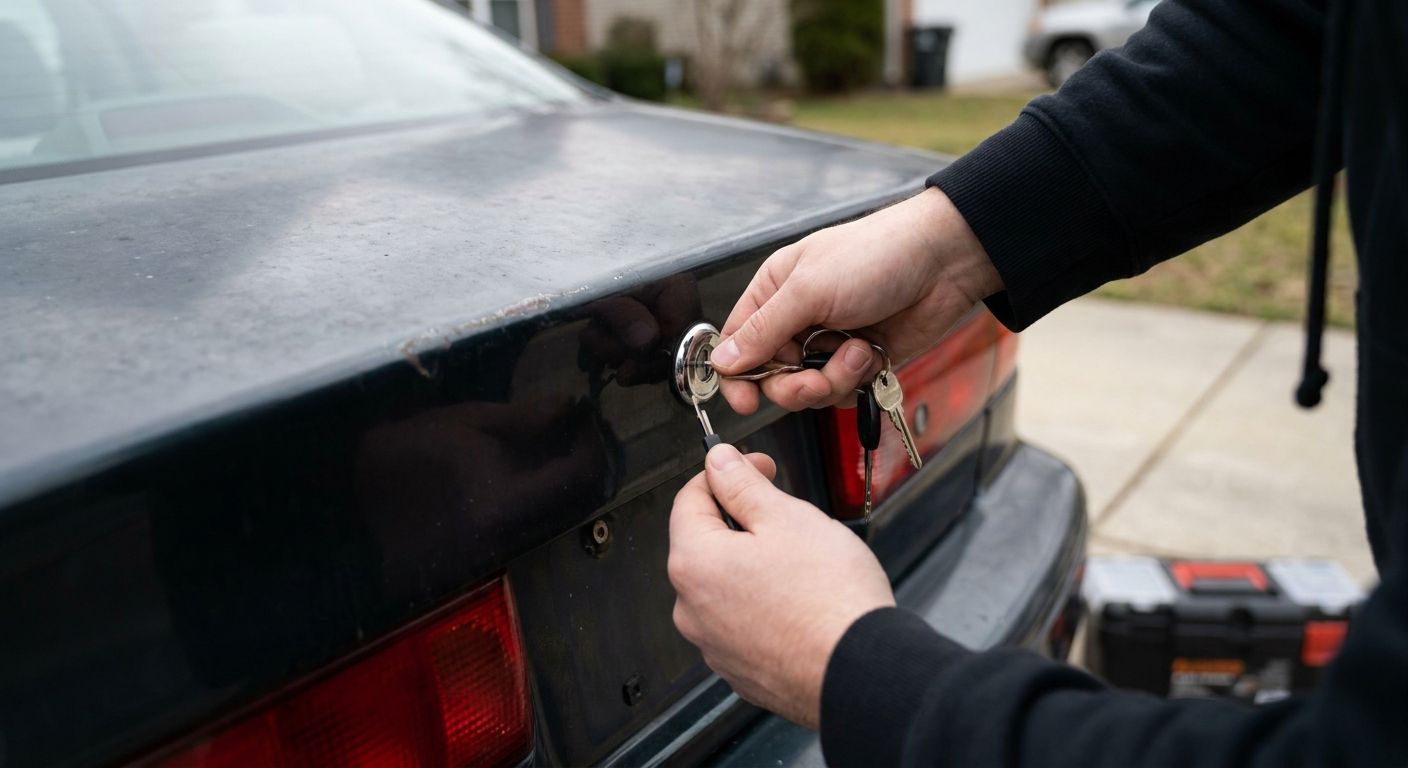
A trunk that won't open with the key or the fob usually comes down to one of four culprits: a dead fob battery, a frozen or corroded cylinder, a broken linkage inside the trunk latch, or a key that's about to snap in the lock. This guide walks through diagnosing which one you're dealing with and what to try before you call for backup.
- A trunk lock won't open most often from a dead key fob battery, frozen cylinder, or worn tumblers inside the latch.
- Never force the key past resistance — that's how keys snap off inside trunk locks.
- Silicone-based lubricant (not WD-40) frees most sticky or frozen trunk cylinders in under 10 minutes.
- If the key won't turn at all or you hear grinding, stop and call Apex Lock N Key before the key breaks.
Why this matters
A trunk lock won't open problem is rarely just annoying — it locks up your spare tire, jumper cables, groceries, or work gear right when you need them. Forcing a stuck key is the single most common way a routine trunk lock won't open call turns into an emergency broken key extraction call in Middlesex County, and the second one costs more time and money than the first. Diagnosing the actual cause before you touch the key with any real force saves the lock and saves the key.
Apex Lock N Key handles trunk lock and latch calls across Middlesex County every week in 2026, and the pattern holds: most trunk lock won't open situations trace back to something fixable in five minutes, not a lock that needs full replacement.
What you'll need
- A flashlight or phone light — trunk cylinders are dark and hard to see into
- Silicone-based lock lubricant (graphite works too; skip WD-40, it gums up over time)
- A spare key, if one exists, to rule out a bent or worn primary key
- A small flathead screwdriver, only for checking the interior release lever, never for prying the cylinder
- 10 to 15 minutes before you decide whether to keep troubleshooting or call a locksmith
- If the key already feels like it's grinding or won't fully seat, stop here and skip straight to calling — don't add "more force" to your toolkit
The steps
1. Rule out the fob and the fuse first
Many trunks release electronically, and a dead key fob battery or a blown trunk-release fuse mimics a "stuck lock" perfectly. Try the trunk release button inside the cabin, then try the fob button, then check your owner's manual for the fuse assigned to the trunk or rear latch circuit. If the fob works on doors but not the trunk, the problem is the latch motor, not the lock cylinder — that changes the fix entirely.
Expected outcome: if the cabin release also fails to pop the trunk, move to the physical key cylinder next. Common mistake: people swap fob batteries and stop testing, missing a fuse that's separately dedicated to the trunk circuit.
2. Inspect the cylinder before inserting the key
Look into the keyhole with a flashlight for debris, rust streaks, or a bent internal pin. Dirt and road salt are the most common blockers on cars parked outside through a Massachusetts winter, and you'll often see a fine orange or gray buildup right at the cylinder face.
Expected outcome: a visibly clean cylinder means the problem is likely internal (tumblers or linkage); visible grime means lubrication is your next move. Common mistake: blowing into the lock — moisture from your breath adds to a rust problem instead of solving it.
3. Apply lubricant the right way
Spray a silicone-based lock lubricant directly into the keyhole, not onto the outside of the trunk lid. Insert the key about halfway and work it in and out five or six times to distribute the lubricant across the tumblers, then remove the key and let it sit 60 seconds before trying a full turn.
Expected outcome: sticky-but-not-frozen locks usually turn freely after one lubrication pass. Common mistake: using WD-40 as a long-term fix — it's a solvent, not a lubricant, and it attracts dust that re-jams the lock within weeks.
4. Turn with steady pressure, not force
Insert the key fully and turn with even, moderate pressure while gently wiggling it up and down a few millimeters. Trunk cylinders often have slightly worn tumblers that need the key seated at a precise angle, so a light rocking motion helps more than raw torque.
Expected outcome: the key turns within 3 to 4 attempts if the tumblers are just worn, not broken. Common mistake: cranking harder when the key resists — that's the exact motion that shears a key inside the cylinder.
5. Check for a frozen lock in cold weather
If temperatures have been at or below freezing, ice inside the cylinder can lock the tumblers in place even with a perfectly good key. Warm the key itself with a lighter for a few seconds (carefully, and never heat the lock directly with an open flame) and try again, or use a de-icer spray made for locks.
Expected outcome: a warmed key clears most freeze-related jams within one or two tries. Common mistake: pouring hot water on the lock — it gets in, refreezes within minutes in New England temperatures, and makes the jam worse.
6. Test the manual trunk release inside the cabin or trunk
Most vehicles built since the mid-2000s have a manual pull-release inside the trunk itself (for anyone trapped inside) or a lever near the driver's seat. If the outside lock and the fob both fail, popping the trunk from inside confirms whether the latch mechanism itself is jammed versus just the exterior cylinder.
Expected outcome: a trunk that opens from the interior release but not the exterior key points to a cylinder-specific problem, not a latch failure. Common mistake: assuming the whole latch is dead when only the exterior lock cylinder has failed.
7. Stop if you feel grinding or the key won't seat fully
Grinding, a key that stops halfway, or a key that feels loose and sloppy in the cylinder are signs of internal damage that lubricant and patience won't fix. At this point the safer move for the car and the key is calling a locksmith rather than continuing to work the key back and forth.
Expected outcome: professional diagnosis in 2026 typically resolves a damaged cylinder in a single mobile visit. Common mistake: repeated attempts "just to be sure" — each attempt increases the odds of the key snapping off inside the lock.
Trunk lock still won't open?
Apex Lock N Key runs mobile calls across Middlesex County, 24/7, in 2026.
Troubleshooting
- Key turns but the trunk still won't pop: the lock cylinder works, but the latch mechanism or release cable is failing — this needs a mechanical inspection, not more lubricant.
- Key won't insert at all: something is physically blocking the keyway, often a broken tumbler pin or corrosion buildup; don't force it, broken key extraction service handles this without damaging the cylinder further.
- Lock is frozen solid even after warming the key: ice has formed deeper in the mechanism; a professional fix for a frozen car door lock in winter approach (safe heat application plus the right de-icer) applies the same way to trunk cylinders.
- Key snapped off mid-turn: stop immediately, don't try to fish it out with tweezers or pliers — that risks pushing the fragment deeper and damaging the tumblers permanently.
- Fob works on doors but not the trunk: this points to a dedicated trunk-release fuse or a failed latch actuator, not the cylinder at all.
- Everything looks fine but the key is just old and worn: a heavily used key thins out over years and stops engaging the tumblers cleanly; a fresh cut key from the original bitting often solves it without touching the lock.
Tools and resources
- Silicone-based lock lubricant, not household oil or WD-40
- A flashlight for inspecting the cylinder before you insert anything
- Emergency locksmith for broken key extraction if a key fragment is already stuck in the cylinder
- How to find a reliable 24 hour locksmith near you if you're troubleshooting outside normal business hours
- A spare key, tested on a working door lock first, to confirm whether the problem is the key or the trunk cylinder itself
What to do next
If your actual keys are the ones stuck inside the trunk rather than the lock refusing to turn, that's a different situation with its own steps — see how to handle a lockout when your keys are locked in the trunk for that scenario specifically. A trunk lock won't open call that turns into a snapped key or a jammed latch is exactly the kind of job a mobile locksmith resolves on-site in 2026 without pulling the whole trunk lid apart.
FAQ
Why won't my trunk lock open with the key?
The most common causes are a dirty or frozen cylinder, worn tumblers, or a failed latch mechanism behind the lock. Lubricating the cylinder with a silicone-based spray resolves most cases that aren't related to a broken key or dead fob.
Is it safe to use WD-40 on a trunk lock?
No, WD-40 is a solvent that dries out and attracts dust, which re-jams the lock within weeks. Use a silicone-based or graphite lock lubricant instead for a fix that lasts.
What should I do if my key breaks off in the trunk lock?
Stop trying to remove it yourself and call a locksmith for broken key extraction. Fishing at a snapped key with pliers or tweezers usually pushes the fragment deeper and damages the tumblers.
Can a frozen trunk lock be fixed without a locksmith?
Warming the key briefly with a lighter and applying a lock-specific de-icer clears most frozen trunk locks in Massachusetts winters. If the lock stays frozen or the key won't turn after warming, a locksmith visit prevents key breakage.
Why does my trunk open from the button but not the key?
This usually means the electronic release circuit works fine but the physical cylinder has worn tumblers or debris. The two systems are mechanically separate, so one can fail while the other keeps working.
How much does it cost to fix a trunk lock in 2026?
Cost depends on whether the fix is lubrication and adjustment or a full cylinder replacement, with mobile service calls priced differently than a shop visit. A locksmith can quote the exact cost after a quick on-site diagnosis.
Can I drive with a trunk lock that won't open?
Yes, driving is safe as long as the trunk is closed and latched, since the lock cylinder is separate from the latch itself. Just avoid forcing the key repeatedly, since that risks snapping it and turning a simple fix into an extraction job.
Do all trunk locks use the same key as the car doors?
Most modern vehicles use one key for doors, ignition, and trunk, but some older models or aftermarket replacements use a separate trunk-only key. Check your owner's manual or test a spare key on a door lock first to confirm.
One last thing
The detail most drivers miss: a trunk lock won't open problem that shows up right after the first hard freeze of the season in Middlesex County is almost always moisture that got into the cylinder during fall rain and then froze solid. Lubricating the cylinder in October, before the first freeze, prevents most of these calls entirely — cheaper and faster than dealing with a frozen or snapped key in January 2026.


