
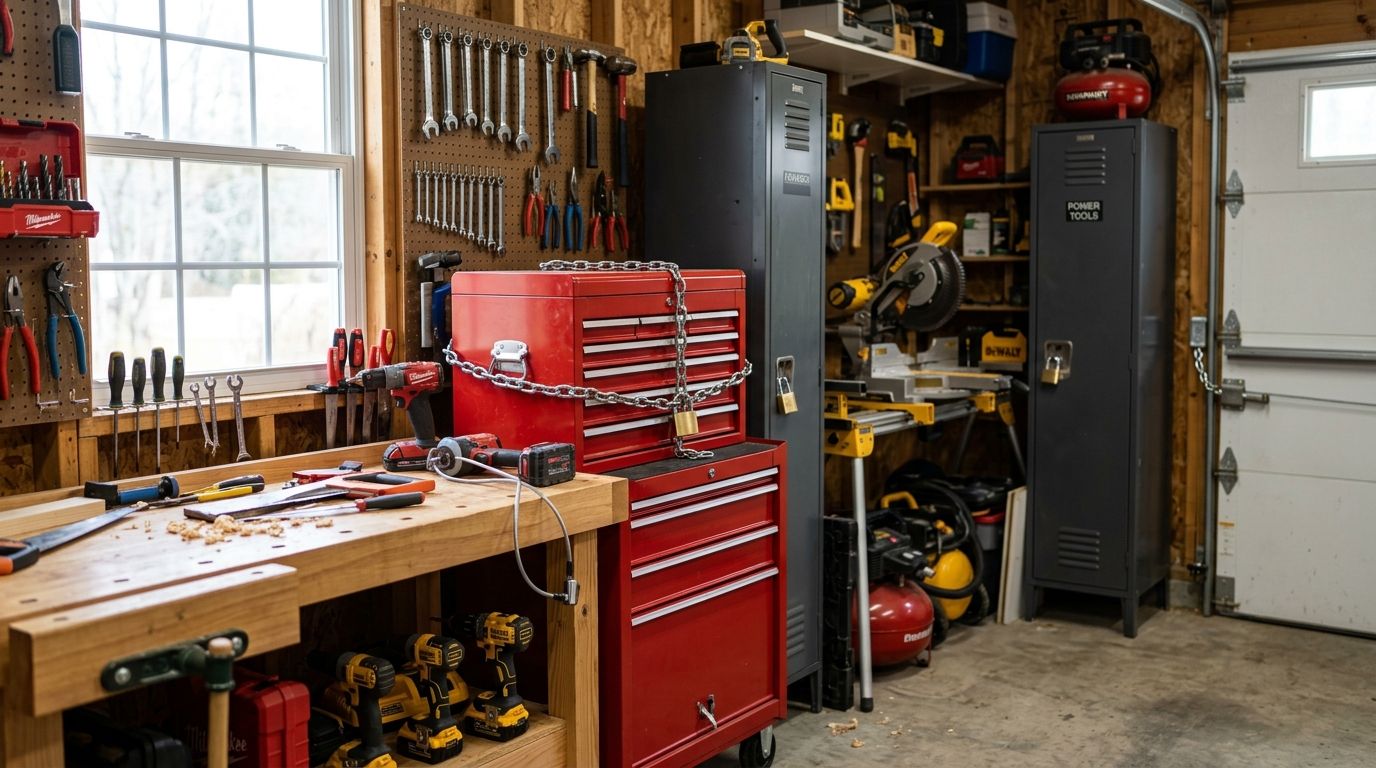
A secure garage workshop needs three things working together: a door that can't be forced, a lock rated for forced-entry resistance, and a way to know if someone tried. Skip any one of those and a stocked tool wall becomes an easy target — most garage break-ins in 2026 still happen through the overhead door itself, not a window or side entry.
- A Grade 1 deadbolt on the workshop's side or service door stops most forced-entry attempts cold.
- Overhead garage doors need a slide bolt or defender bracket — the standard emergency release cord is a known weak point.
- Keyed-alike systems let you secure a garage workshop tools setup with one key instead of five.
- Motion-triggered lighting and a keypad or smart lock add a deterrent layer without rewiring the whole garage.
- A licensed locksmith can rekey or upgrade hardware in one visit — no need to replace the whole door.
Why this matters
Table saws, welders, compressors, and hand tool collections routinely run into five figures of replacement value, and most homeowners insurance policies cap unattached-structure theft coverage well below that. A garage isn't built like a house — most overhead doors rely on a single motorized latch, not a deadbolt, and the side or service door often still has the original builder-grade lock from move-in day. That combination is exactly what makes garages a preferred entry point in Middlesex County and across Massachusetts.
The fix isn't complicated, but it does need to happen in the right order. A high-security deadbolt on the entry door, a mechanical backup on the overhead door, and a habit of locking both every time closes most of the gap.
How do you secure a garage workshop with high-value tools?
Start with the door people actually walk through, then reinforce the big overhead door as a second layer.
- Replace the side/service door lock with a Grade 1 deadbolt. ANSI/BHMA Grade 1 hardware is rated for the highest forced-entry resistance in residential locks — most garage service doors still have Grade 2 or 3 hardware from construction.
- Add a slide bolt or manual lock to the overhead garage door track. The motorized opener is not a security device on its own; a $20-range slide bolt on the inside of the track stops the door from being forced up even if the opener is bypassed.
- Secure or shield the emergency release cord. That red cord lets you disengage the opener from inside — it's also the single most documented method for defeating a garage door from outside using a wire or hook through the top seam.
- Rekey or upgrade any lock inherited from a previous owner or contractor. If you don't know who has a copy of the key, the lock is not secure, no matter how new it looks.
- Add motion-activated lighting at the entry points. Deterrence works before a break-in is attempted — most opportunistic theft targets the least-lit access point on a property.
- Consider a keyed-alike system if the workshop connects to other structures. One key for the house, garage, and workshop side door beats juggling three separate keys, and it's a standard job for a residential rekeying visit.
Comparing the two main lock upgrade paths
| Option | Best for | Pros | Cons |
|---|---|---|---|
| Grade 1 mechanical deadbolt | Homeowners who want a set-and-forget lock | No batteries, proven forced-entry rating, lower long-term cost | No remote access or activity log |
| Keypad or smart lock | Households sharing access with family or contractors | Code changes on demand, no lost-key risk | Needs power source, more moving parts to fail |
A Grade 1 deadbolt on the workshop door is the single highest-impact upgrade for anyone trying to secure a garage workshop tools setup in 2026 — it's the layer most builder-grade garages skip entirely.
Grade 1 deadbolt: the entry-door fix that matters most
Grade 1 is the top residential rating under the ANSI/BHMA A156.36 standard, tested for strike resistance, cycle life, and pick resistance well above the Grade 2 and Grade 3 hardware installed in most new-construction garages. If the service door leading into the workshop still has its original lock, that's the first thing to swap — everything else is a second layer behind it. Apex Lock N Key installs Grade 1 hardware on garage and workshop doors throughout Middlesex County, and a same-visit upgrade typically doesn't require replacing the door itself.
Overhead door hardening: the mechanical backup layer
The motorized opener on a standard overhead garage door is convenience hardware, not a lock — it's rated for daily cycling, not forced entry. A slide bolt mounted to the inside track, or a defender bracket over the emergency release mechanism, adds physical resistance that the opener alone doesn't provide. This matters even more for a workshop garage that isn't attached to the main house, since it often gets less foot traffic and less attention.
Why garage workshop security gets overlooked
- Builder-grade locks stay in place for years. Most homeowners never touch the original hardware unless something breaks.
- Attention goes to the front door, not the garage. Security upgrades tend to start at the main entrance and stop there.
- The overhead door feels "locked" because it's closed. A closed door isn't the same as a secured one if the release mechanism is exposed.
- Tool inventories grow gradually. A garage that started with a lawnmower slowly becomes a workshop worth protecting, and the locks never catch up.
- Insurance gaps aren't discovered until after a loss. Unattached-structure and personal-property limits are often lower than owners assume.
- Rekeying gets skipped after a move or a contractor job. Anyone with a spare key from the previous cycle still has access unless the lock is changed.
Get a garage workshop lock upgrade quote
Licensed, 24/7 mobile service across Middlesex County, MA.
What's the best lock for a garage workshop door?
A Grade 1 deadbolt is the best lock for a garage workshop door because it carries the highest residential forced-entry rating available and doesn't rely on batteries or a power source. Pair it with a mechanical slide bolt on the overhead door track for a two-layer setup that covers both entry points.
Do smart locks work for a garage workshop?
Yes, smart locks work for a garage workshop side door, and they add code-based access control that a standard deadbolt can't offer. The tradeoff is a battery or wired power requirement, which matters more in a detached garage than it does on a house entry door — check that placement before committing to one.
Should the overhead garage door have its own lock?
Yes — the overhead garage door should have a slide bolt or track lock separate from the motorized opener. The opener is a convenience mechanism, not a forced-entry barrier, and a mechanical backup closes that gap without any wiring changes.
FAQ
What's the best way to secure a garage workshop with high-value tools?
Install a Grade 1 deadbolt on the entry door and a slide bolt or defender bracket on the overhead door track. Both together close the two main forced-entry paths into most residential garages.
Is a smart lock better than a traditional deadbolt for a workshop?
A traditional Grade 1 deadbolt has a higher forced-entry rating and no battery dependency, making it the more reliable primary lock. A smart lock adds convenience through code-based access but works best as a secondary layer.
How do burglars typically break into a garage workshop?
The most documented method targets the emergency release cord on overhead garage doors, using a hook or wire fed through the top seam. Shielding or securing that cord removes the single most common bypass technique.
Do I need to rekey my garage lock after buying a house?
Yes — rekey any garage or workshop door lock after closing, since previous owners, contractors, or agents may still hold copies of the old key. A licensed locksmith can rekey the existing hardware in one visit without replacing the lock body.
Does homeowners insurance cover stolen tools in a garage?
Coverage varies by policy, and unattached-structure or personal-property limits are frequently lower than the value of a stocked workshop. Check the policy's specific sublimits before assuming full replacement value is covered.
What lock rating should a workshop door have?
Look for ANSI/BHMA Grade 1 hardware, the highest residential forced-entry rating under the current standard. Grade 2 and Grade 3 locks, common in builder-grade construction, offer noticeably less resistance.
Can a locksmith upgrade a garage door lock without replacing the door?
Yes, in most cases a locksmith installs new deadbolt or slide-bolt hardware onto the existing door frame. Full door replacement is rarely required just to upgrade the lock.
Should a detached workshop garage use the same key as the house?
A keyed-alike system lets one key operate the house, garage, and workshop locks, which is common for property owners managing multiple structures. It's a standard configuration a locksmith can set up during a rekeying visit.
One last thing
The overhead door's emergency release cord is the part almost nobody thinks to secure, and it's the part most documented in garage break-in reports. A five-minute fix — a shield, a zip tie release, or a repositioned cord — closes that gap for less effort than any lock upgrade on this list. Pair it with the Grade 1 deadbolt on the service door and the workshop's two weakest points are covered before 2026 is over.


