
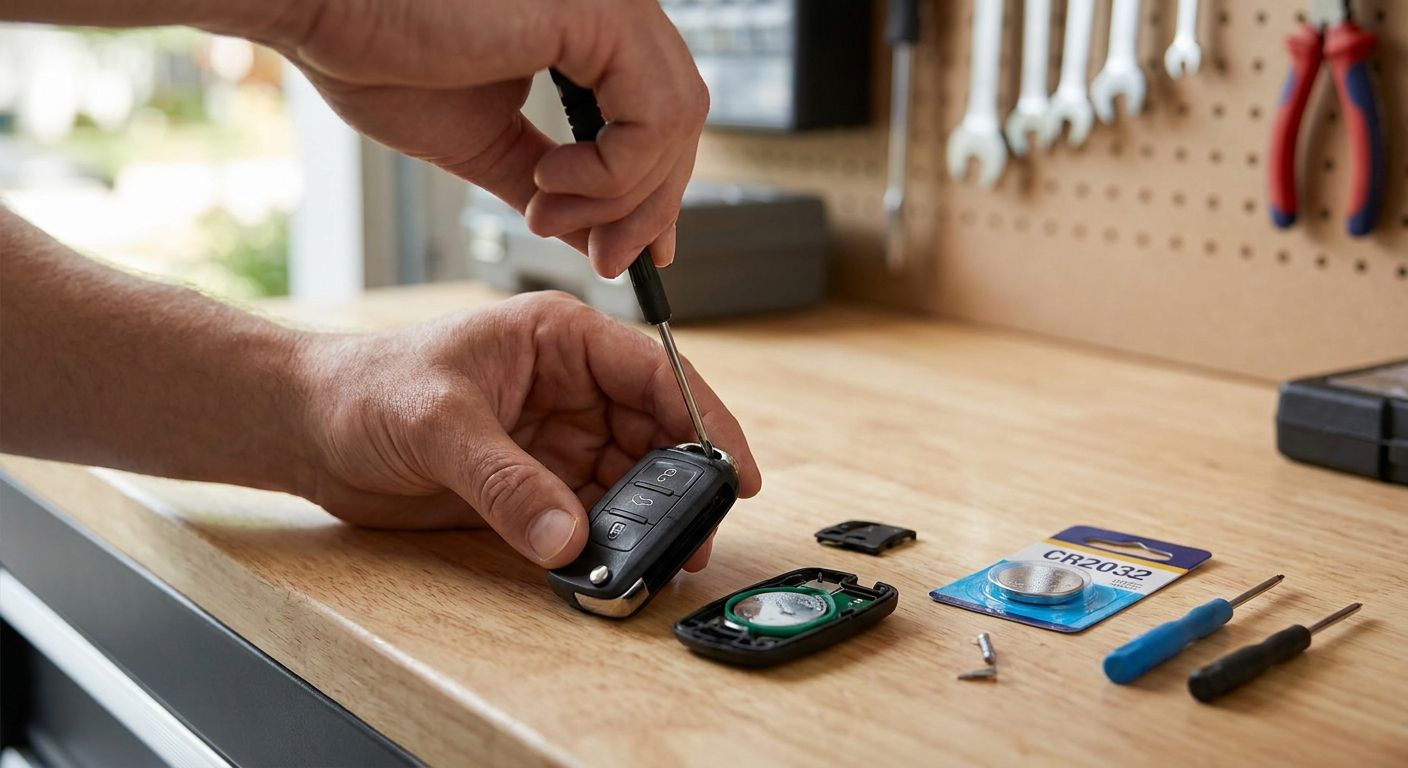
A dead car key fob battery causes false lockouts, no-start warnings, and short-range unlocking, but swapping it takes under 10 minutes with the right coin cell and a little care. This guide walks through car key fob battery replacement step by step, plus what to do if your fob still won't work after the swap.
- Most fobs use a CR2032 or CR2025 coin cell battery you can swap in under 10 minutes.
- Car key fob battery replacement doesn't require reprogramming on most vehicles built after 2010.
- Pry seams gently with a flathead or plastic tool — cracked fob shells are the most common DIY mistake.
- If the fob still won't communicate after a fresh battery, the transponder chip or sync needs a locksmith, not a new battery.
Why this matters
A fob that's slow to respond or only works a few feet from the car isn't broken — it's usually just low on power. Coin cell batteries in key fobs last 1 to 4 years depending on use, and most drivers don't realize the fix is a $3-$5 part until they've already called a dealer. Doing car key fob battery replacement yourself saves a service visit for the one issue that's genuinely simple, and knowing the failure signs helps you tell a dead battery apart from a bigger transponder problem before you start prying the case open.
What you'll need
- Replacement coin cell battery — check your fob for the size printed inside (CR2032 and CR2025 are the most common in 2026 model-year fobs)
- Small flathead screwdriver or a plastic pry tool (a butter knife works in a pinch, but it scratches the housing)
- A soft cloth or towel to work on, so small screws and buttons don't roll away
- 5 to 10 minutes, uninterrupted
- Your spare key, if you have one, in case the fob won't restart cleanly
If you're not sure which battery your fob takes, or you're dealing with a foreign or luxury model with a sealed fob housing, an automotive locksmith for foreign and luxury car brands can confirm the part before you buy the wrong size.
The steps
1. Identify your fob type and battery
Open your current fob and look for a battery number stamped on the coin cell itself — CR2032 (3V, larger, most common) and CR2025 (3V, slightly thinner) cover the majority of vehicles on the road in 2026. Buying the wrong size is the top reason DIY replacements fail on the first try. Expected outcome: you're holding the correct replacement battery before you open the fob body.
2. Remove the mechanical key blade
Most fobs hide a small metal key blade for manual door entry — find the release button or slide switch, usually on the side or back, and pull the blade free. Skipping this step risks bending the blade or scratching the fob when you pry the case apart. Expected outcome: the blade is out and the fob body is clear to open.
3. Open the fob housing
Insert your flathead or pry tool into the seam where the two halves meet — usually near where the key blade was — and twist gently rather than forcing it. Common mistake: prying at the wrong seam cracks the plastic clip, which then makes the fob rattle even after reassembly. Expected outcome: the case splits into two halves without visible damage.
4. Note the battery orientation before removing it
Before touching the old battery, note which side faces up — most fobs mark this with a "+" symbol next to the correct facing side. Photograph it with your phone if you're not confident you'll remember. Expected outcome: you know exactly how the new battery needs to sit before the old one comes out.
5. Swap the battery
Pop the old battery out with a fingernail or the flat tool, avoiding contact with the circuit board underneath. Wipe the new battery with a dry cloth before inserting it — oil from your fingers can cause corrosion on the contacts over months of use. Expected outcome: the new coin cell sits flush and doesn't rock in its slot.
6. Reassemble and test immediately
Snap the housing back together, reinsert the key blade, and test the fob's lock and unlock buttons while standing 15-20 feet from the car before you get in. Common mistake: closing the case with the battery slightly off-center, which breaks the circuit contact and makes the fob look dead when it isn't. Expected outcome: lock, unlock, and panic buttons all respond with a chirp or light flash.
7. Confirm keyless start and remote start still work
If your vehicle has push-button start or remote start, test both after the swap — these draw more power than basic lock/unlock and sometimes expose a battery that's technically working but weak. Expected outcome: the car starts and the fob is recognized inside the cabin without needing to hold it against the start button.
Fob still won't sync after a new battery?
Apex Lock N Key handles transponder and reprogramming issues across Middlesex County, MA.
Troubleshooting
- Fob does nothing after the battery swap. Reopen the case and check the battery orientation — a reversed coin cell won't damage the fob, but it also won't power it.
- Buttons feel mushy or unresponsive. The rubber contact pad under the buttons can shift during reassembly; reopen, reseat the pad, and press firmly while closing the case.
- Fob works only inches from the car. This is usually a weak battery even if it's new — try a second fresh battery from a different pack before assuming a bigger fault.
- Fob shows no light or chirp at all. Check for a blown fuse in the fob's circuit or corrosion on the battery contacts; a cotton swab with rubbing alcohol clears light corrosion.
- Car doesn't recognize the fob for push-button start. Some vehicles need a brief resync after a battery pull — check your owner's manual for the specific relearn sequence before assuming the transponder failed.
- Fob housing won't snap shut. A cracked internal clip from prying at the wrong seam means the case needs tape or replacement — it won't affect function, but it will rattle.
If you've gone through this list and the fob still won't communicate with the car, the issue is likely the transponder chip or the vehicle's receiver module, not the battery — that's a job for a locksmith with programming equipment, not another coin cell.
Tools and resources
- Replacement coin cell battery matched to your fob's printed size
- Small flathead or plastic pry tool
- Your owner's manual, for vehicle-specific relearn procedures
- Best car key replacement service for lost transponder keys if the fob needs full replacement rather than a battery
- Mobile locksmith for stranded drivers on the highway if the battery dies somewhere without easy access to a hardware store
What to do next
If your fob works fine after the swap but you've also misplaced a spare, don't wait until you're down to one working key. Read how to replace a lost car key without the original fob to understand what a full replacement involves in 2026, since it's a different process than a battery swap and usually needs vehicle registration and ID on hand.
FAQ
What battery does a car key fob use?
Most car key fobs use a CR2032 or CR2025 3-volt lithium coin cell, printed on the battery itself. Some European models use a CR1620 or CR1632, so check before buying a replacement.
How much does car key fob battery replacement cost?
The battery itself costs $3-$8 at most hardware or auto parts stores in 2026. A locksmith visit for the same swap typically runs higher once labor and a service call are included.
Do I need to reprogram my fob after replacing the battery?
Most vehicles built after 2010 don't require reprogramming for a simple battery swap. Some push-button start systems need a brief relearn sequence, which your owner's manual will list.
How long does a car key fob battery last?
A fob battery typically lasts 1 to 4 years depending on how often you use the remote functions versus the mechanical key. Cold weather also drains coin cell batteries faster.
Why won't my key fob work even with a new battery?
If the fob still doesn't communicate after a fresh battery, the transponder chip, contact pad, or the car's receiver module is likely the issue, not the power source. That points to a locksmith visit rather than another battery swap.
Can I replace a fob battery myself or do I need a locksmith?
Replacing the battery is a DIY job for the vast majority of fobs and takes under 10 minutes with a small screwdriver. A locksmith is only necessary if the fob needs reprogramming, the housing is damaged, or the transponder itself has failed.
Is it safe to open my key fob myself?
Yes, opening a fob to swap the battery doesn't void anything on most vehicles and involves no electrical risk. The only real danger is cracking the plastic housing if you pry at the wrong seam with too much force.
What if my fob won't open or the seam won't budge?
Some fobs, especially on foreign and luxury brands, use sealed housings that resist standard pry tools. In that case, a locksmith familiar with those models can open and service the fob without cracking it.
One last thing
Corrosion on the battery contacts, not battery age, is the reason a lot of "dead" fobs stay dead even after a fresh coin cell goes in — a quick wipe with a dry cloth or alcohol swab during the swap in 2026 fixes more fobs than the new battery does on its own.


