
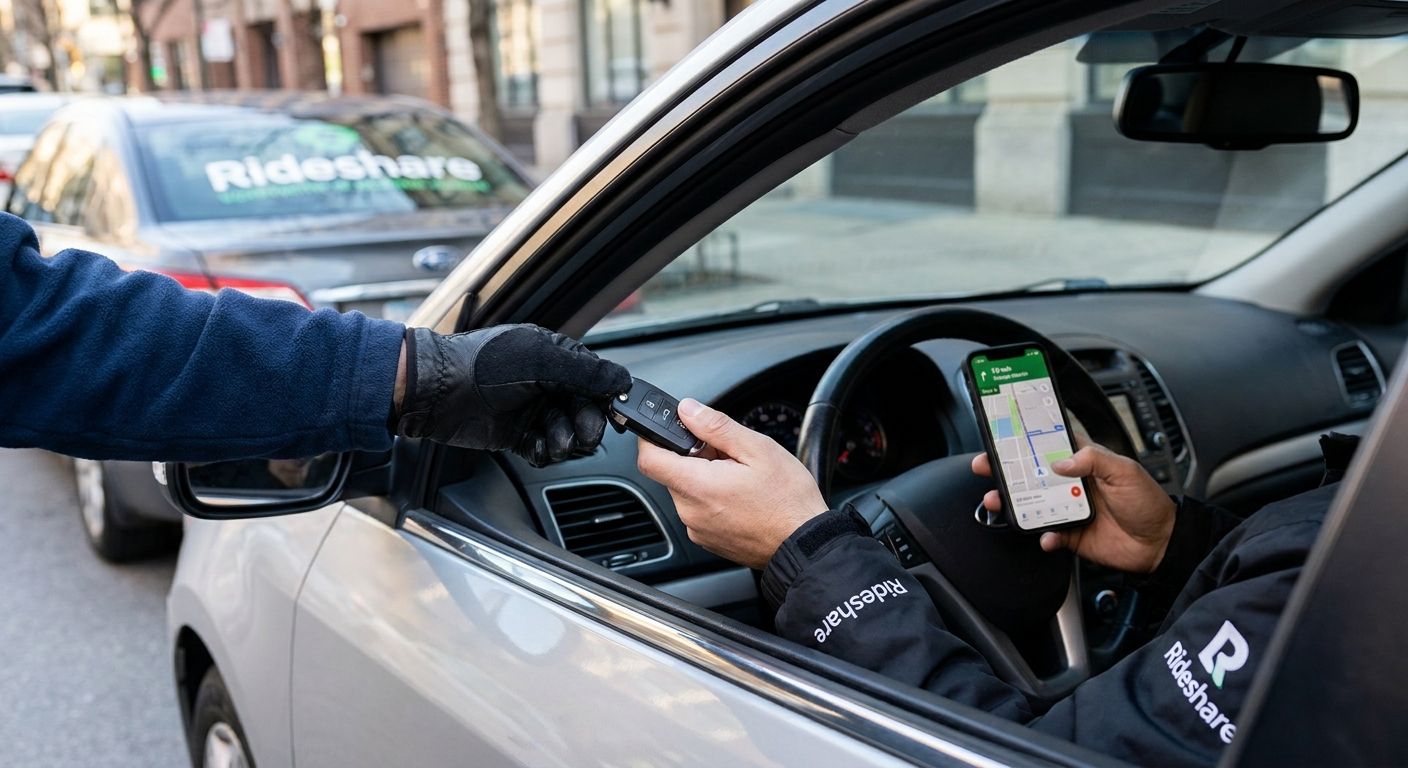
Uber and Lyft drivers need car key replacement service that works around a paid shift, not a service department's calendar. The job itself is the same as any transponder key or fob replacement — cutting a new key, programming the chip to the car's immobilizer — but the stakes are different when the car is how you earn money. A locksmith who shows up curbside and gets you back online in one visit beats a dealership appointment every time you're mid-shift.
- Car key replacement for rideshare drivers works best as a mobile, on-site job — towing to a dealership costs a shift's worth of fares.
- Push-to-start fobs need immobilizer programming, not just cutting; mail-order keys often arrive unprogrammed and won't start the car.
- Roadside assistance through insurance usually covers lockouts, not lost or broken key replacement — check the fine print before you rely on it.
- Apex Lock N Key runs 24/7 in Middlesex County, which matters more to rideshare drivers working nights and weekends than a 9-to-5 dealership schedule.
- Keep a spare key cut and stored outside the car the same day you replace one — the next lockout is a matter of when, not if.
Why car key replacement matters for rideshare drivers
A locked-out or keyless rideshare car earns nothing while it sits. Every hour spent waiting on a dealership appointment or a mail-order key is an hour off the app, and Uber and Lyft don't pause the bills while you wait. Dealership service departments that special-order a transponder key can run several business days depending on the part, and most only operate during standard weekday hours.
Rideshare income skews toward nights, weekends, and event surges — exactly when dealerships are closed. A driver who loses a key at 1 a.m. on a Saturday needs a locksmith who answers at 1 a.m. on a Saturday, not a voicemail that says "call back Monday." Apex Lock N Key runs mobile service around the clock in Middlesex County for this reason.
Drivers who track vehicle expenses for taxes or mileage deductions also need a receipted job, not a workaround. A documented locksmith visit gives you that paper trail; a borrowed spare or a jury-rigged fix doesn't.
1. Identify your key type before you call anyone
Knowing what you're dealing with saves time on the phone and on-site.
- Check whether it's a basic metal key, a transponder key with an embedded chip, or a push-to-start fob
- Look for a "push to start" button on the dash — that means fob-only ignition with no cylinder to pick or turn
- Check the glovebox or owner's manual for an FCC ID printed on any spare you still have
- Note the exact year, make, model, and trim — chip type and programming steps vary even within the same model year
- If you drive a fleet or rental rideshare vehicle, confirm which specific car you're in that shift before assuming it matches last week's
2. Try the manual workarounds first
Before paying for a service call, rule out the free options.
- Search the car itself for a hidden spare in the center console, trunk liner, or glovebox
- Call whoever last had access to a spare — a partner, family member, or a previous driver on a shared fleet vehicle
- Check your auto insurance policy for roadside assistance coverage, but confirm it covers lockouts, not key cutting or programming
- Contact the dealership only to check if a spare key is on file — most transponder keys still require in-person programming once cut
3. Call a mobile locksmith instead of towing to a dealership
Once you've confirmed there's no spare, a mobile locksmith is usually faster than a tow plus a dealership queue.
- A mobile locksmith cuts and programs the key at your location — no tow truck, no waiting room
- Apex Lock N Key's transponder key replacement service covers most transponder-equipped vehicles without a scheduled appointment
- Confirm the technician is licensed and insured before they work on your ignition or steering column
- Ask upfront whether the visit includes programming for keyless entry remotes, not just cutting the metal key
4. Get push-to-start fobs programmed on-site, not mailed
A push-to-start fob that looks correct still won't start the car if it isn't paired to the vehicle's immobilizer.
- Push-to-start systems require the fob to be programmed to the car's computer, not just physically cut
- On-site push-to-start key fob programming confirms the fob works before the technician leaves
- Mail-order fobs frequently arrive unprogrammed — they'll unlock nothing and won't crank the engine
- Test keyless entry, remote start, and trunk release before signing off on the job
5. Build a backup plan for the next lockout
One key replacement should turn into two keys, not a repeat service call next month.
- Cut a spare the same day the primary replacement is programmed
- Store the spare somewhere other than the car — a bag, a drawer, not the glovebox
- Swap out a weak fob battery before it dies mid-shift rather than after you're stranded
- Keep the locksmith's receipt for tax records if you deduct vehicle expenses on your rideshare income
6. Plan around the odd-hours reality of rideshare driving
Rideshare income leans heavily on nights, weekends, and surge events — the hours a dealership is closed.
- Save a 24/7 locksmith's number in your phone before you need it, not while standing in a parking lot at 1 a.m.
- Factor lockout risk into which vehicle you drive on overnight shifts, especially older cars with worn ignition cylinders
- Treat a sticky ignition or a fob that's slow to register as an early warning, not something to ignore until it fails completely
Comparing your options as a rideshare driver
| Option | Best for | Key limitation |
|---|---|---|
| Mobile locksmith | Drivers who need the car running again the same shift | Not every locksmith stocks every transponder chip on the truck |
| Dealership service department | Drivers with a flexible schedule and a factory warranty question | Appointment waits and business-hours-only service |
| Roadside assistance (insurance or AAA) | Getting into a locked car when the original key still exists | Doesn't cut or program a lost or broken key |
| Mail-order key kit | Budget-conscious drivers with time to spare | Self-programming often fails on late-model immobilizer systems, and shipping adds days |
Verdict: for a working rideshare driver, a licensed mobile locksmith is the only option on this list that solves the problem the same day, at the location the car is stuck.
Locked out mid-shift?
24/7 mobile car key replacement in Middlesex County, MA.
Common mistakes rideshare drivers make
- Waiting to see if a lost key "turns up" instead of calling for a replacement immediately — every hour off the app is an hour of unpaid downtime.
- Ordering a mail-order transponder key without checking if the vehicle needs immobilizer programming, not just a cut blank.
- Assuming insurance roadside assistance covers key replacement — most plans only cover lockouts where a working key already exists somewhere.
- Letting a weak fob battery die without a spare on hand, then assuming the ignition itself has failed instead of checking the battery first.
- Skipping a licensed, insured locksmith to save time, then having no recourse if the ignition or steering column gets damaged during the job.
FAQ
What is car key replacement for rideshare drivers?
It's a mobile locksmith service that cuts and programs a new transponder key or push-to-start fob on-site, so an Uber or Lyft driver can get back on the app without towing the car to a dealership. It covers lost keys, broken keys, and fobs that stop working mid-shift.
How fast can a locksmith replace a lost car key for a rideshare driver?
A mobile locksmith cuts and programs most transponder keys during a single on-site visit, which is faster than a dealership appointment that may require ordering the part first. Availability depends on the specific vehicle and chip type.
Can a locksmith program a push-to-start fob on the spot?
Yes, a mobile locksmith can pair a new push-to-start fob to the vehicle's immobilizer on-site in 2026, the same programming step a dealership performs. Mail-order fobs typically arrive unprogrammed and won't start the car until this step happens.
Does roadside assistance cover a lost car key?
Most roadside assistance and insurance plans cover getting into a locked car when a working key still exists, not cutting or programming a lost or broken key. Check your specific policy before assuming it covers a full key replacement.
What should I do if I'm locked out during a rideshare shift?
Check for a hidden spare in the car first, then call a mobile locksmith who can cut and program a new key at your location instead of towing to a dealership. Keep the receipt for mileage or expense records if you track vehicle costs.
Can I use a mail-order key kit for my rideshare vehicle?
You can order a blank key by mail, but most late-model vehicles need in-person immobilizer programming that a mail-order kit can't perform. Self-programming instructions often fail on push-to-start and transponder systems.
Is a mobile locksmith a better option than a dealership for rideshare drivers?
For a driver who needs the car running again the same shift, a mobile locksmith avoids the tow and the appointment wait a dealership requires. A dealership still makes sense for drivers with flexible schedules and no urgency to get back on the road.
What information does a locksmith need to cut a new transponder key for a rideshare car?
A locksmith needs the vehicle's year, make, model, and trim, plus proof of ownership such as registration or a title. Having this ready before the technician arrives speeds up the visit.
One last thing
Most "the car won't start" calls that sound like an ignition failure turn out to be a dead fob battery, not a mechanical problem. Before assuming you need a full car key replacement, swap the battery — it rules out the cheapest possible cause before you commit to a bigger repair, and it takes less time than driving to a dealership to find out the same thing.


